
Total Shoulder Replacement
Arthritis, anatomic versus reverse replacement, and what the operation actually does — plus how we diagnose it, how surgery is scheduled, and what the first six months look like.
Call 520-881-1394 Read the packetWho this is for
This page is for people whose shoulder arthritis is getting in the way of work, the things they enjoy, or sleep, especially if medications, physical therapy, bracing, or injections are no longer enough.
It is also for people whose rotator cuff is torn or diseased in a way that would make a conventional replacement fail. Those patients may do better with a reverse total shoulder. Surgery is not automatic. He and his physician assistants, Olivia Sobojinski, PA, and Gabby Ventura, PA, listen first and review the options with you. There is no single path that fits everyone.
What happens at your visit
You will usually have an X-ray in the office. We look at it together, talk about non-surgical options as well as anatomic versus reverse replacement, and you decide on a timeline that fits your life.
If you decide to schedule surgery later, you can do that in clinic with Dr. Ward, or call the office after your visit.
"Had a reverse total shoulder replacement 3 weeks ago. In and out of hospital in 4 hours. Dr. Ward did an excellent job. The post op x rays showed perfect placement of the implants. Recovering well." — Google review
Understanding arthritis
Shoulder replacement treats arthritis: loss of the cartilage that lets the ball and socket glide. Cartilage is only a few millimeters thick. Once it is gone, the body cannot grow it back.
Bare bone is rough. Rough bone rubbing on rough bone causes inflammation, swelling, and pain. Treatment starts by calming those symptoms — medications, physical therapy or home exercises, bracing, and injections. If that stops working and the shoulder is affecting work, the things you enjoy, or sleep, surgery may be next.
How we diagnose it
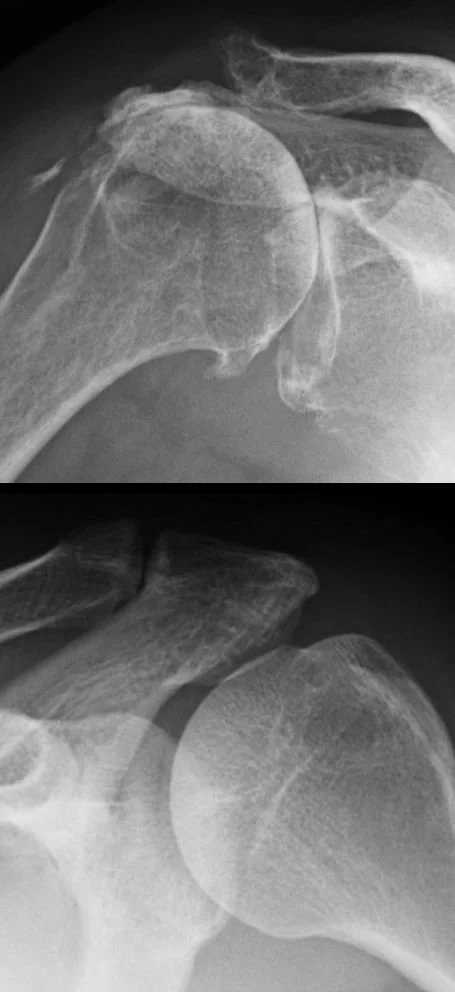
X-ray is the main test for osteoarthritis. Cartilage itself does not show on X-ray. What we are looking for is the space between the ball and the socket. Which implant you get is decided after exam and X-rays together in clinic.
On X-ray
Arthritis on X-ray is loss of space between the bones — the cartilage is gone. Extra signs can include bone spurs and a joint that no longer lines up the way it should.
If the space is preserved, the cartilage is likely still there.
The rotator cuff
People with shoulder arthritis can also have a torn or diseased rotator cuff. The cuff helps raise the arm and keeps the ball in the socket.
That is why the visit is about more than bone-on-bone. An intact or repairable cuff can support an anatomic replacement. A torn cuff is often a reason to choose reverse.
Anatomic vs. reverse
The two operations are related, but they are not interchangeable. Which one fits depends on whether the rotator cuff can still raise the arm and keep the ball in the socket.
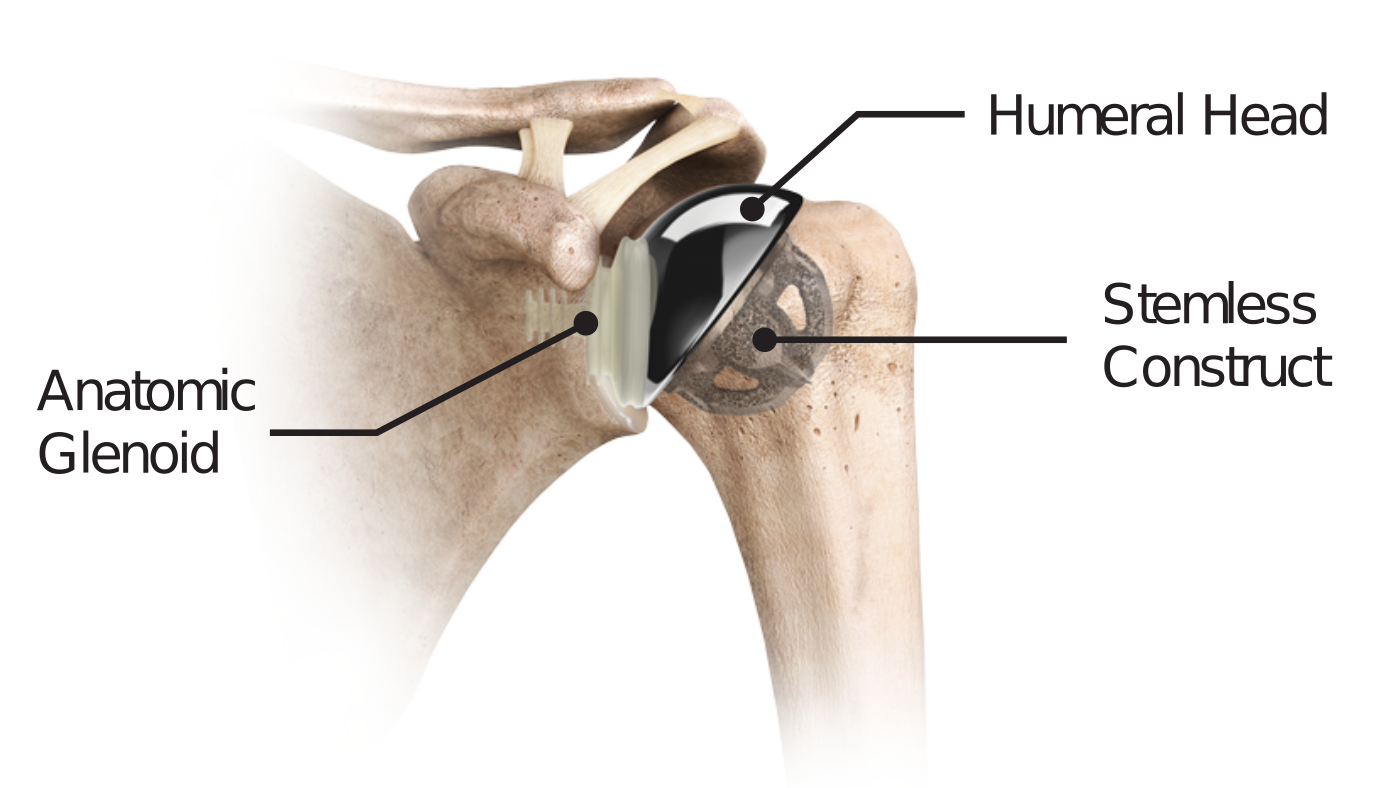
Anatomic (conventional)
Replaces the worn ball and socket with another ball and socket. The rotator cuff still has to raise the arm and hold the ball in place.
An anatomic total shoulder needs an intact or repairable cuff. If the cuff is torn, a conventional replacement can fail, and people can keep having problems.
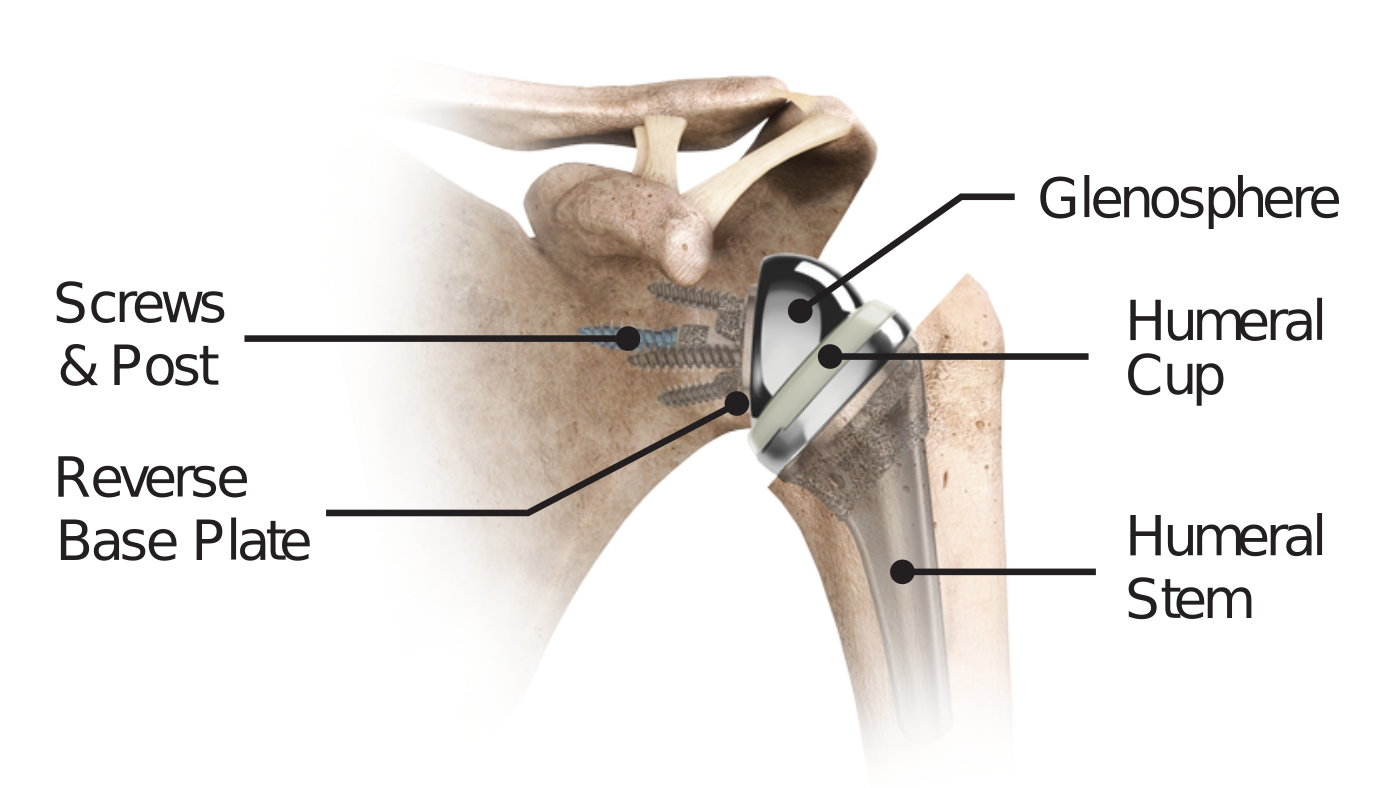
Reverse
Flips the ball and the socket: the ball becomes the socket and the socket becomes the ball. You no longer need the cuff to lift. The large deltoid muscle over the shoulder does the work instead.
Reverse has been very successful for a diseased or torn cuff. It is also used for cuff-tear arthropathy, massive irreparable cuff tears, complex proximal humerus fractures, revision, and severe glenoid bone loss. That decision is made together in clinic. See also surgical services.
What the surgery actually is
The incision is deltopectoral: from just below the collarbone onto the upper shoulder. Absorbable sutures are under the skin. Nothing to remove.
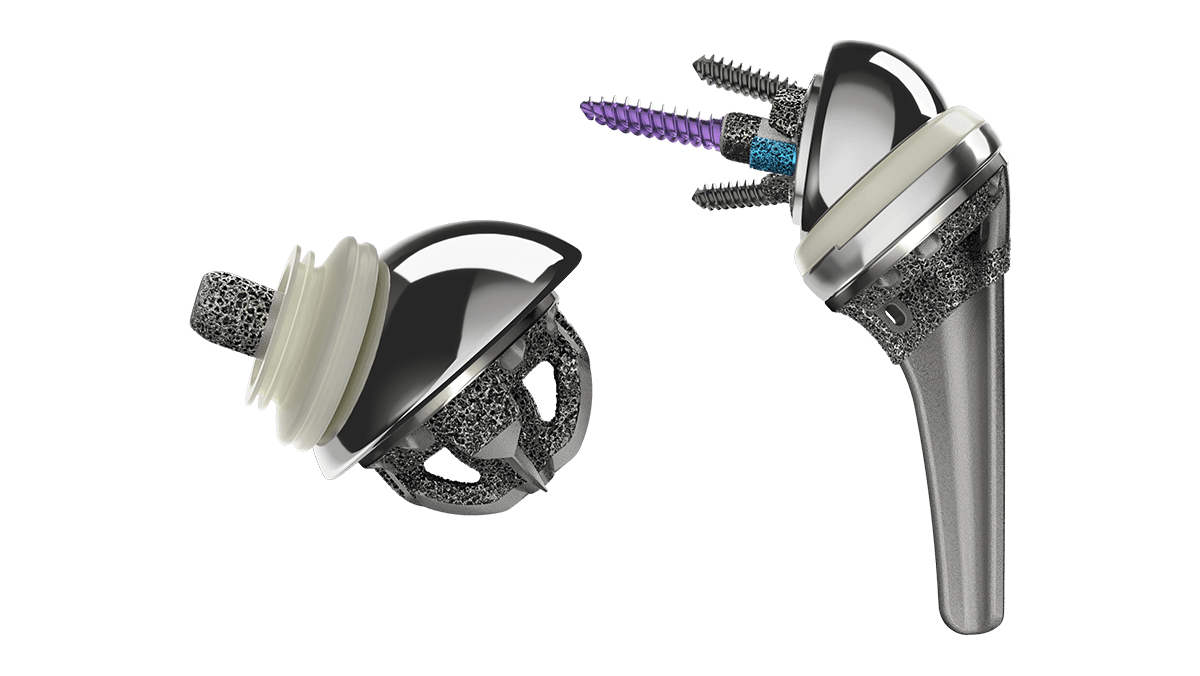
To enter the joint, the subscapularis tendon (the muscle that internally rotates the arm) is cut. Tendons take about six weeks to heal, which is why the sling and the rotation limits matter. Anatomic replacement keeps ball-and-socket geometry. Reverse switches them so the deltoid can lift the arm.
Scheduling and Dr. Ward's approach
You can schedule surgery in clinic with Dr. Ward, or call the office after your visit. Leave a message if needed. Dr. Ward or a physician assistant will see you before surgery to answer any remaining questions.
Dates and hospital
Alison Guerra, the surgery scheduler, will call with available dates for you to choose from. Surgery is performed at Oro Valley Hospital or Northwest Medical Center, based on your preference.
Insurance
A total shoulder is elective, but it is generally considered medically necessary after non-operative care has failed. Our office handles insurance pre-approval. Call your plan for details on your deductible and expected out-of-pocket costs.
Yvette, the sling representative, sets you up with a sling and an ice machine before surgery. Bring the sling to the hospital if you have already been given one. Leave the ice machine at home. An ice cuff is a popular way to keep the shoulder cold; insurance often covers it, and Dr. Ward can help you get one.
What to expect
Before
You will have a preoperative visit one to two weeks beforehand to review labs, discuss questions, plan pain control, and arrange a physical therapy referral. Hospital testing can usually be done without an appointment. Do not eat anything after midnight the night before surgery.
Day of
Surgery typically lasts 60–90 minutes. Dr. Ward generally recommends a nerve block, which typically lasts 12–24 hours — stay ahead of the pain when it wears off. After about 30–45 minutes in the recovery room, most people go home the same day. He calls the person you designate when surgery is finished.
Recovery
Similar to rotator cuff rehab. Physical therapy about 7–10 days after surgery. Sling when you are up and moving for six weeks. By twelve weeks many people start hiking, golf, and swimming. By six months most are back to full activity.
Before surgery
Most of the work happens before the operating room. Write questions down. Bring them to the preoperative visit.
Pre-op visit
- About one to two weeks before surgery
- Labs and any remaining questions (write them down)
- Pain plan
- Physical therapy referral
- Yvette sets up the sling and ice machine
Testing
No appointment is needed at Oro Valley Hospital or Northwest Hospital for:
- CBC, BMP, PT/INR
- Chest X-ray
- EKG
Medical clearance from your PCP is needed if you have lung, heart, or kidney problems. It is not needed for cholesterol or stable high blood pressure. If you see a cardiologist, anesthesia requires cardiology clearance as well.
Medications
- Stop aspirin 7 days before surgery
- Blood thinners are stopped only with guidance from your PCP or cardiologist
- Restart them the evening of the day after surgery unless you are told otherwise
Night before and morning of
- Nothing to eat after midnight. Eating means the case is canceled.
- A sip of water only for morning heart medications
- Shower the morning of surgery with regular over-the-counter soap. No special soap is needed. Avoid soap that contains lotion.
Prehab
Bike, elliptical, and water exercise are good. No impact. Strength, motion, and endurance before surgery help the recovery that follows.
Physical therapy starts about 7–10 days after surgery. You will also have home exercises to start before that first PT visit.
Home setup
- Clear rugs and cords
- Keep frequently used items within easy reach so you are not reaching or bending
- Carry a phone with you during recovery
- Plan for pets and small children so they are not underfoot when you come home
Day of surgery
Bring
- Comfortable clothes and shoes
- Sling, if it was given to you before surgery
- Phone, ID, and insurance card
- A ride home
- Glasses (no contacts)
- Dentures, if you wear them (you will remove them for surgery)
Leave at home
- Ice machine
- Jewelry and rings
- Home medications
- Makeup
Anesthesia
A loved one can be with you in pre-op. Dr. Ward and anesthesia meet you there.
Dr. Ward generally recommends a nerve block so the shoulder and arm are numb when you wake up. The block typically lasts 12–24 hours. Stay ahead of the pain once it starts coming on. Anesthesia will help you decide which anesthetic is best for you.
Timing
- About 15–20 minutes to go to sleep
- Surgery 60–90 minutes
- Recovery room about 30–45 minutes. He calls the person you designate right after.
- Then home the same day.
Incision and dressings
The incision runs from just below the collarbone to the upper shoulder (deltopectoral). Absorbable sutures are under the skin. Nothing to remove.
- Mepilex adhesive for 7 days — keep it dry
- Prineo mesh is glued on for about 3 weeks. Showers are fine. No soaking. Trim it as it peels.
Recovery
Stay ahead of the pain for the first three days. Sharp pain eases after 1–2 weeks. A night ache like a toothache is common around six weeks. Recovery is similar to rotator cuff rehab.
Pain, ice, swelling
- Ice is one of the best pain killers after shoulder replacement
- An ice cuff is popular and easy to keep on; insurance often covers it
- Bruising around the shoulder, down the chest, and even to the hand is common and usually settles in a week or so
The sling and the subscapularis
Wear the sling when you are up and moving for the first six weeks. You may take it off to rest, sleep, do home exercises, or simple in-front tasks with the elbow at your side — eat, write, read, use the phone.
No internal or external rotation: don't scratch your back, don't reach for the seatbelt. Forward flexion and abduction are okay right away.
Physical therapy
Plan on about three months of physical therapy, starting about 7–10 days after surgery. How fast motion and strength come back depends a lot on how strong the shoulder was going in.
Driving
Not while you are on narcotics.
You need to grip the steering wheel with both hands and react quickly. That is generally 4–6 weeks after surgery.
Work
- Desk work: minimum about 2 weeks. Most people are more comfortable at 4.
- Standing jobs: minimum about 4 weeks. Most people need 6.
Hip or knee next
If a hip or knee also needs surgery, wait until about the 3-month mark. You will need a walker after hip or knee replacement, and the shoulder needs that time first.
Common questions
These answers come from the packet. If something still does not make sense, come in. You are not wasting anyone’s time.
There is a pimple on the incision.
That is often a suture abscess. The body is breaking down suture under the skin. It does not usually need antibiotics. It can pop like a pimple, or you can show Dr. Ward.
I see a fishing-wire suture.
That is suture spitting. You can clip it with nail clippers or leave it. It will eventually fall out on its own.
It feels warm and a little red.
Extra blood flow can make the shoulder feel warm and look a little red for up to about three months. That can be normal healing. It decreases with time.
It's been 6 weeks and my shoulder still aches.
That is very common. Physical therapy stretches scar tissue as motion comes back. An ache can last up to around three months and usually improves as you get full range of motion.
When can I drive?
When you can hold the steering wheel with both hands and react quickly. That is generally 4–6 weeks after surgery. Do not drive while taking narcotic pain medication.
When should I worry?
Infection can look like normal healing. Come in rather than wait. You are not wasting anyone’s time by being cautious. He would rather reassure you that everything is normal than miss an infection.
Do I need antibiotics for the dentist?
Take antibiotics before invasive dental work that may cause bleeding. They are not needed for a routine cleaning. Call the office if you are unsure.
Will I set off airport scanners?
Most likely. Every airport is different, but about 90% of joint implants set off security. You do not need a card, and you do not have to show the scar. Plan extra time.
When can I have my hip or knee done?
Wait until about the 3-month mark. Baseline recovery takes typically three months, and you will need a walker after hip or knee replacement.
Related resources
The packet covers the details: preparing for surgery, the day of, sling rules, and week-by-week recovery. This page is the short version. The PDF is the full one.
Read the packet (PDF) Total Shoulder Replacement Post-Op Instructions (PDF)Schedule a visit
Call 520-881-1394 and we will find a time that works.
Call 520-881-1394