
Approaches to the Knee
How the surgeon gets into the knee for replacement matters for exposure, soft-tissue recovery, and early motion. Dr. Ward’s standard approach is quadriceps-sparing when your anatomy allows — the technique many patients know by brand names like “Jiffy Knee.” You do not need to ask for it.
Call 520-881-1394 Total knee replacementWhat “approach” means
The implant (Dr. Ward uses the DePuy Attune system) is one decision. The surgical approach is another: the path through the soft tissues to reach the joint. Different approaches spare different parts of the quadriceps (the large muscle that straightens the knee).
Dr. Ward’s standard: quadriceps-sparing
Quadriceps-sparing approaches avoid splitting the quadriceps tendon. That is the technique patients often hear about under marketing names. For Dr. Ward it is the default plan whenever anatomy allows — you do not need to request it. If a wider exposure is safer for your knee, he will explain why and adjust.
Quadriceps-sparing (midvastus / subvastus)
The vastus medialis muscle is split or lifted rather than cutting through the main quad tendon. Early straight-leg raise and quad control are often easier for many patients. This is what brand phrases like “Jiffy Knee” usually refer to — an approach style, not a special implant.
- Avoids a formal split of the quad tendon
- Dr. Ward’s usual approach when anatomy allows
- Still a full total knee with modern implants when indicated
You do not need to ask
Online and word-of-mouth marketing has made quad-sparing very visible. People want less disruption of the muscle that powers knee extension. In this practice it is already the planned approach when your anatomy, deformity, prior surgery, and implant plan allow.
You do not need to request a “Jiffy”-style or quad-sparing exposure — that is Dr. Ward’s standard. He will say so if a different approach is the better choice for your knee.
See the difference
Same knee, three soft-tissue paths. Red marks the approach. Quad-sparing options (midvastus and subvastus) leave the main quadriceps tendon intact.
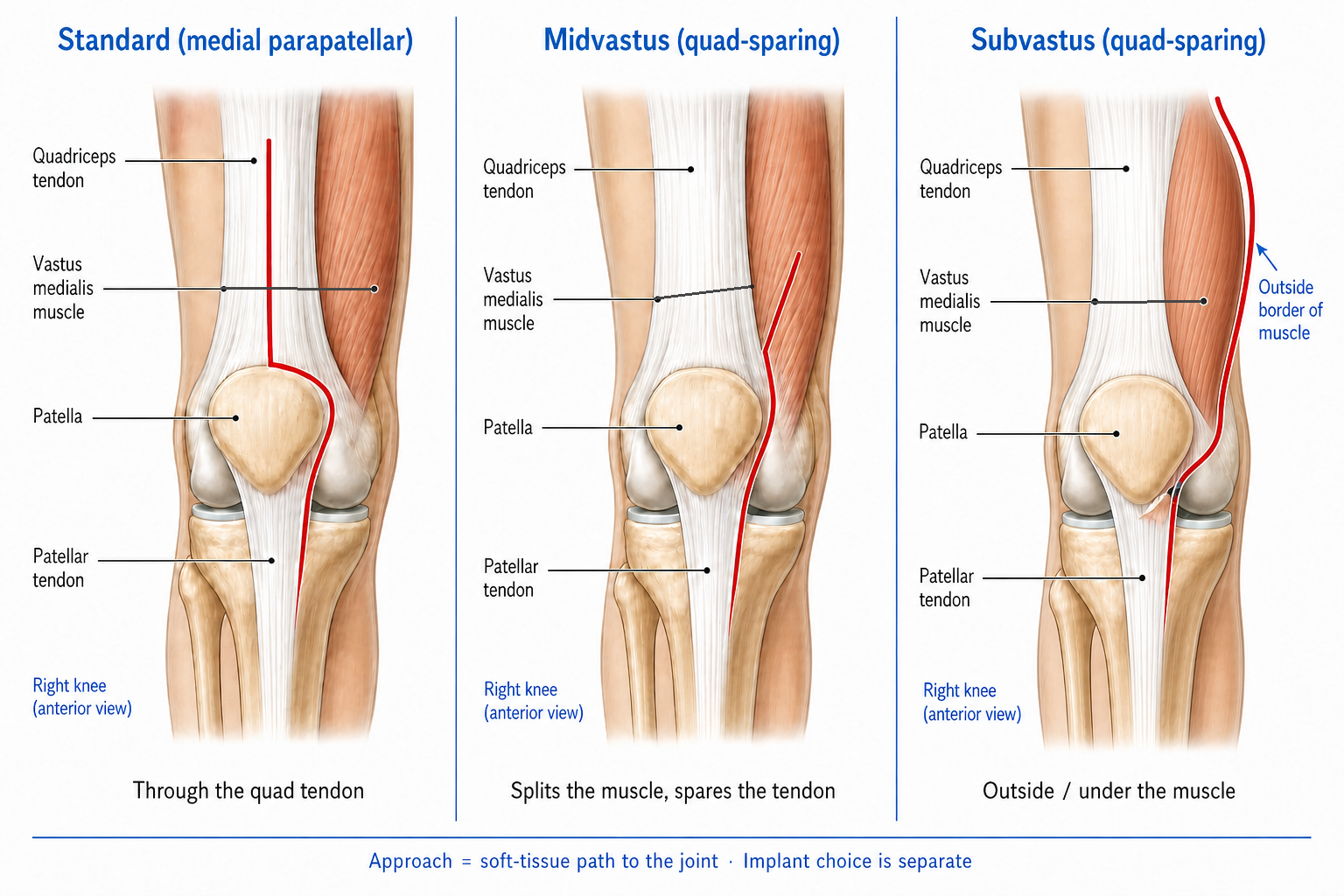
The three common approaches
All three have been used for years. The “best” choice depends on your knee, not a slogan.
Medial parapatellar (standard)
The classic exposure. Part of the path goes through the quadriceps tendon. It gives a very clear view of the joint, which helps with complex deformity, revision work, or when maximum visualization is needed.
Midvastus
Splits the vastus medialis muscle rather than the full quad tendon. A common quadriceps-sparing option that balances exposure with muscle preservation.
Subvastus
Goes under the vastus medialis without cutting the quad tendon. Another true quad-sparing path; exposure can be tighter in some body types or stiff knees.
Quad-sparing is Dr. Ward’s standard when anatomy allows. Standard (medial parapatellar) exposure remains excellent when the case needs a wider view. The implant, alignment, and recovery plan matter as much as the soft-tissue path.
What about “Jiffy Knee”?
“Jiffy Knee” is marketing language for a quadriceps-sparing surgical approach — not a unique brand of knee implant. Clinics that advertise it are usually describing midvastus or subvastus soft-tissue handling. That is already Dr. Ward’s standard approach when anatomy allows, using the same Attune implant system as his other knee replacements. Patients do not need to ask for it by name.
How this fits your total knee
Approach is decided with the rest of your plan: whether you need total vs partial replacement, Attune implant sizing, and your recovery goals. Most of the bone work (trimming worn surfaces and placing metal and plastic components) is the same idea regardless of soft-tissue path.
Read the full patient overview on the Total Knee Replacement page, including diagnosis, day of surgery, and recovery.
You do not need to request quad-sparing — it is the usual plan when it fits. Dr. Ward or a physician assistant will still walk through which approach fits your knee and why, including if a wider exposure is safer.
Common questions
Is quadriceps-sparing always used?
It is the usual plan when anatomy allows. Some knees need a wider standard (medial parapatellar) exposure — for example complex deformity, stiffness, or revision work. Dr. Ward matches the approach to the case and will tell you if the plan changes.
Does quad-sparing change which implant I get?
No. Dr. Ward uses the DePuy Attune knee system. Approach and implant are separate choices.
Will I recover faster?
Some patients notice easier early quad activation after a sparing approach. Overall recovery still depends on therapy, swelling control, and your starting strength. Expect a structured rehab plan either way.
Do I need to request this approach?
No. Quadriceps-sparing is Dr. Ward’s standard approach when anatomy allows. You do not need to ask for it. If a different exposure is better for your knee, he will explain that plan.
Related resources
Total knee replacement Knee arthroscopy Physical therapy locations Knee packet (PDF)Schedule a visit
Call 520-881-1394 to talk through approach options for your knee.
Call 520-881-1394