
Knee Arthroscopy & Meniscus Resection
When a torn meniscus is trimmed arthroscopically through small portals — plus how we diagnose it, what surgery involves, and how recovery is paced from the first weeks through return to sport.
Call 520-881-1394 Post-op instructions (PDF)Who this is for
This page is for people whose meniscus tear is causing pain, catching, or locking, especially after rest, medications, physical therapy, or other non-operative care have not been enough.
Not every tear needs surgery. Some improve with non-operative care. Others stay painful or mechanical enough that arthroscopic treatment is the better next step. Dr. Ward and his physician assistants, Olivia Sobojinski, PA, and Gabby Ventura, PA, review the exam and imaging with you and decide together.
What happens at your visit
You will have a focused knee exam. Many patients already have an MRI, or one is ordered to show the tear and the rest of the joint. We talk through continued non-operative care versus arthroscopy and a timeline that fits your life.
If you decide to schedule surgery later, you can do that in clinic with Dr. Ward, or call the office after your visit.
Understanding the meniscus
The menisci are C-shaped cushions of cartilage between the femur and tibia. They help the knee absorb load, stabilize the joint, and protect the articular cartilage on the ends of the bones.
A tear can happen from a twist or squat, or from wear over time. Tears can cause pain along the joint line, swelling, catching, or locking. Treatment often starts with activity modification, medications, and physical therapy. If symptoms persist and an unstable fragment is catching or locking the knee, arthroscopic partial meniscectomy (meniscus resection) can remove the torn tissue while leaving as much healthy rim as possible.
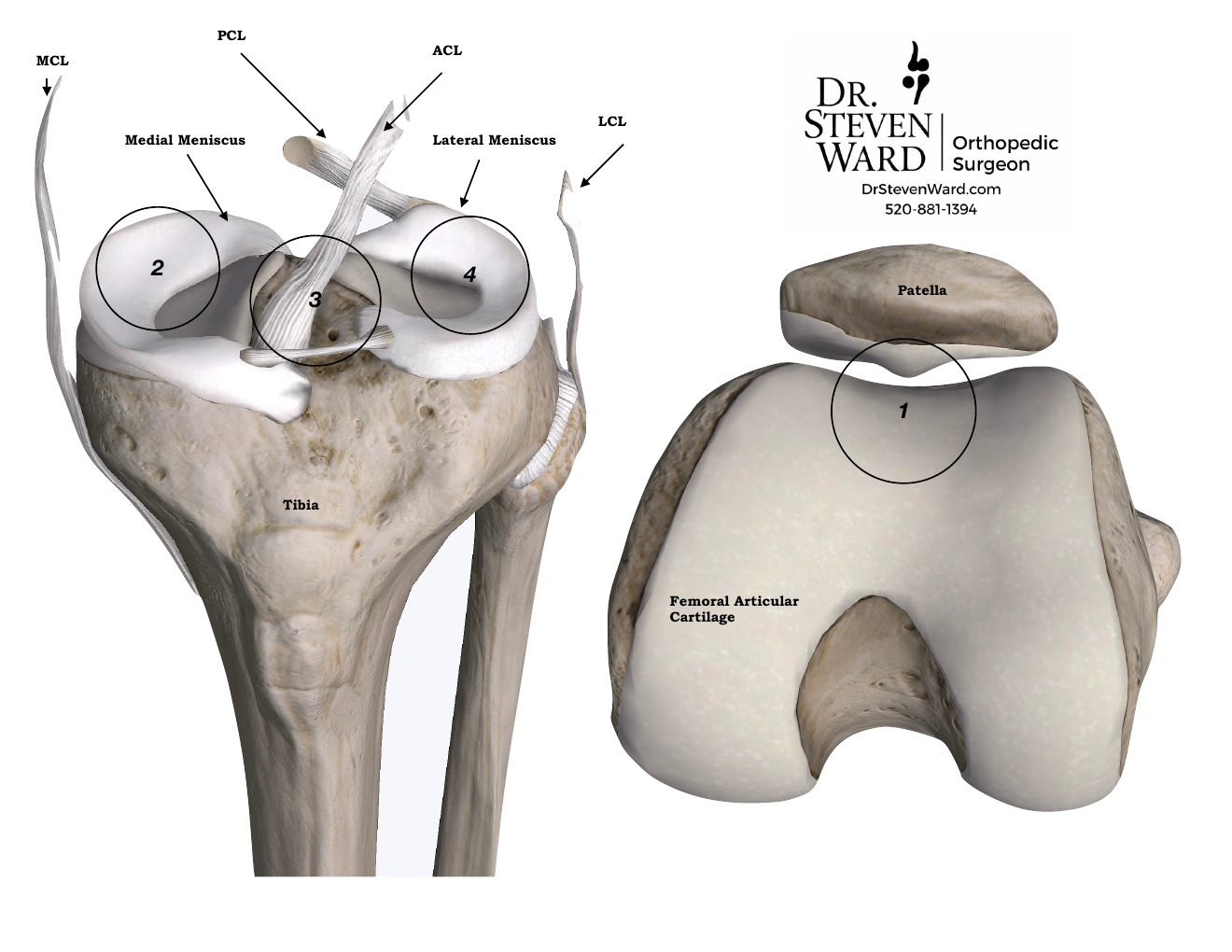
What the numbers mean
The numbered spots on the anatomy figure are common places we talk about in clinic. Numbers 2 and 4 are the medial and lateral menisci — the cushions most often treated with arthroscopic resection when torn.
1 — Patellofemoral joint
Where the kneecap meets the femur. A common source of front-of-knee pain if the cartilage is damaged or the kneecap does not track in the groove. Treatment may include debridement, cartilage repair, or, when damage is severe, replacement options discussed in clinic.
2 — Medial joint space / meniscus
Contains the medial meniscus and medial joint cartilage. The medial meniscus is the cushion most often injured. Repairable tears may be repaired; more often an unstable tear is treated with resection (partial meniscectomy). This side is also a common place for arthritis.
3 — ACL
The anterior cruciate ligament helps keep the tibia from sliding forward and limits excessive rotation. Tears can cause instability or a giving-way feeling and often need reconstruction with autograft or allograft when indicated.
4 — Lateral joint space / meniscus
Contains the lateral meniscus and lateral joint cartilage. Tears and cartilage damage are less common than on the medial side, but treatment follows the same principles: repair when appropriate, or resection / cartilage care when needed.
How we diagnose it
Diagnosis starts with the history and a careful exam. X-rays help rule out arthritis and other bone problems. An MRI is often used to see the meniscus tear and to look at the cartilage, ligaments, and other soft tissues that matter for planning.
Exam
We check motion, swelling, joint-line tenderness, and which movements recreate catching, locking, or pain. Those patterns help decide whether a meniscus tear is likely driving your symptoms.
Imaging
X-ray shows bone and joint space. MRI shows soft tissue: tear location and pattern, and whether other structures are involved. Those findings guide whether arthroscopic resection is likely to help.
What the surgery actually is
Knee arthroscopy is done through small portal incisions. A camera and instruments go into the joint so Dr. Ward can see the tear, remove unstable fragments, and smooth the remaining meniscus.
Partial meniscectomy (meniscus resection) trims the torn tissue that is catching or locking. Healthy rim is left in place when possible so the meniscus can keep cushioning the joint. Other findings inside the knee are addressed as needed based on what is seen at surgery.
Scheduling
You can schedule surgery in clinic with Dr. Ward, or call the office after your visit. Leave a message if needed. Preoperative instructions are reviewed in clinic before the day of surgery so you know what to bring, what to stop, and when to arrive.
Dr. Ward or a physician assistant will see you before surgery to answer remaining questions. Write them down and bring them to that visit.
What to expect
Before
You will have a preoperative visit to review questions, plan pain control, and arrange a physical therapy referral. The office gives day-of instructions in clinic. Do not eat after midnight the night before surgery unless you are told otherwise.
Day of
Bring comfortable clothes, ID, insurance card, and a ride home. Dr. Ward and anesthesia meet you in pre-op. Anesthesia discusses the plan that is best for you. Most people go home the same day after time in the recovery room. He calls the person you designate when surgery is finished.
Recovery
Weight-bearing as tolerated with crutches you wean as able. Early goals include pain and swelling control, motion from 0–90°, and quadriceps control. Strengthening builds through weeks 7–12. You may start returning to sports activities at 4–6 weeks as you tolerate it and as cleared in clinic.
Recovery phases
These timelines come from Dr. Ward’s meniscus resection rehab protocol. Your therapist may adjust details based on how your knee and motion progress.
Healing phase (weeks 1–6)
Goals: control pain and swelling, allow the knee to heal, begin range of motion from 0–90°, and regain quadriceps control (eliminate extensor lag).
- Weight-bearing: as tolerated; wean off crutches and progress activity as you tolerate it
- Driving: when completely off crutches and no longer taking narcotic medication
- Precautions: no lifting more than 25 lbs; no ladder or step stool
- Ice: 45 minutes on / 15 off during weeks 1–2, then 3 times a day or as needed for pain
- Massage: soft tissue massage may begin at week 2; trigger-point work for hip, thigh, and lower leg as directed
- Exercises weeks 1–2: calf pumps; heel slides; calf, hamstring, and buttock contractions; upper body OK
- Exercises weeks 3–4: terminal knee extension (TKE); straight leg raises; partial squat with chair; standing quad stretch; practice normal walking; stationary bike with seat high, then gradually lower
- Exercises weeks 5–6: single-leg partial knee bend; hip extension endurance; step-ups forward and lateral; sitting TKE; hamstring stretches; pool walking (no aggressive kicking)
Wound care & pain (healing phase)
- Leave the dressing 3 days, then band-aids; reapply a dressing if there is drainage until dry
- Keep the incision dry until day 7, then shower; do not submerge until day 30
- Leave steri-strips until they fall off, or remove at 14 days
- Gentle scar massage at 2 weeks; no lotion on the incision until day 30
- Days 1–3: take pain medication on a schedule
- Days 3–14: taper narcotics; keep NSAID and Tylenol scheduled; narcotic at night and after PT as needed
- Day 14+: narcotic only at night if needed; Tylenol as needed; NSAID scheduled until week 6
Motion & strengthening (weeks 7–12)
Goals: control pain and swelling, progress to full range of motion, and strengthen the quadriceps.
- Wound: may submerge if incisions are fully healed; deep scar massage; Vitamin E lotion OK
- Crutches: no longer needed in this phase
- Precautions: avoid running; prefer flat-foot aerobics (bike, elliptical)
- Ice: when the knee is swollen; soft tissue massage continues
- Pain: Tylenol as needed; NSAID; narcotics generally not required
- Weeks 7–8: bike with lower seat and more resistance; gait training; progressive lower-extremity strengthening with emphasis on quad extension
- Weeks 9–10: walk preferably no more than 2–3 miles; resistance training (leg press, squats to 90°, deep flexion stretches)
- Weeks 11–12: bike, elliptical, stairmaster; full swimming OK
Return to sport (from 4–6 weeks)
Goals: you may start returning to sports activities at 4–6 weeks as pain, swelling, and strength allow, with the aim of equal strength and full occupational activity.
- Progress activity gradually; stop or limit anything that causes lasting swelling or pain, then rest, ice, compress, and elevate
- Narcotics are not required in later recovery; Tylenol at night and before therapy as needed
- Continue progressive lower-extremity strengthening, balance, and flat-foot cardio (bike, elliptical) as motion allows
- Advance running and higher-impact sports only when the knee is quiet and clinic or physical therapy clears you
- Discharge when: you can return to the activities you need without ongoing swelling or instability, with strength progressing toward the other side
Temporary setbacks are common as you increase intensity. New discomfort behind the kneecap can happen if the quadriceps weaken a bit after arthroscopy — which is why the exercises matter. If your knee swells or hurts after a specific activity, limit or stop that activity until you feel better, then RICE: Rest (limit weight-bearing for the first few days after symptoms appear), Ice (cold packs 20 minutes at a time, several times a day; do not apply ice directly on skin), Compress with an elastic bandage, and Elevate with the knee above heart level.
Home exercises (weeks 1–6)
Names below match Dr. Ward’s meniscus resection packet. The packet includes illustrated how-to steps. Your therapist will cue form; do not push through sharp pain.
Weeks 1–2
- Calf pumps
- Heel slides (supine)
- Calf, hamstring, and buttock contractions
- Upper body exercises as tolerated
Weeks 3–4
- Terminal knee extension (TKE)
- Straight leg raises
- Partial squat with chair
- Standing quadriceps stretch
- Practice walking normally (without looking down)
- Stationary bike — seat high, then gradually lower
Weeks 5–6
- Partial single-leg knee bend
- Hip extension endurance
- Step-ups forward and lateral
- Sitting terminal knee extension
- Hamstring stretches (sitting and with wall)
- Pool walking — avoid aggressive kicking
Common questions
These answers come from the rehab protocol. If something still does not make sense, call the office or come in.
When can I put weight on the leg?
You may begin weight-bearing when you are able to tolerate it (WBAT). Wean off crutches and progress activity as you tolerate it.
When can I drive?
When you are completely off crutches and are no longer taking narcotic medication.
When can I shower?
Keep the incision dry until day 7, then you may shower. Do not submerge the knee under water until day 30. In weeks 7–12 you may submerge if the incisions are completely healed.
How much can I lift in the first six weeks?
No lifting more than 25 pounds. Do not climb a ladder or step stool during the healing phase.
What about the dressing and steri-strips?
Leave the dressing three days, then switch to band-aids. Leave white steri-strips until they fall off, or remove them at 14 days. Gentle scar massage may begin at two weeks. Do not put lotion on the incision until day 30. Later you may use Vitamin E lotion and deeper scar massage once the wound is ready.
How should I use ice after surgery?
Weeks 1–2: keep ice on the knee for 45 minutes, then remove it for 15 minutes. After weeks 1–2, reduce to 3 times a day or as needed for pain. Weeks 7–12: when the knee is swollen, ice it for 45 minutes, then remove it for 15 minutes.
When can I return to sports?
You may start returning to sports activities at 4–6 weeks as you tolerate it. Progress gradually. Prefer bike or elliptical early if impact bothers the knee, and clear higher-impact or contact play with Dr. Ward or your therapist before you push hard.
What if my knee swells or hurts after exercise?
Temporary setbacks are common. New discomfort behind the kneecap can happen if the quadriceps weaken after arthroscopy. Limit or stop the aggravating activity until you feel better, then RICE: rest, ice (20 minutes at a time, not directly on skin), compress with an elastic bandage, and elevate the knee above heart level.
Related resources
Knee Arthroscopy Post-Op Instructions (PDF) Meniscus Surgery Packet (PDF) Meniscus Tear Handout (PDF) Total knee replacement Physical therapy locations Exercises OrthoInfo.orgSchedule a visit
Call 520-881-1394 and we will find a time that works.
Call 520-881-1394