
Total Knee Replacement
Arthritis, total versus partial replacement, and what the operation actually does — plus how we diagnose it, how surgery is scheduled, and what the first twelve weeks look like.
Call 520-881-1394 Read the packetWhen anatomy allows, Dr. Ward’s usual technique for total knee replacement is quadriceps-sparing — the soft-tissue approach many patients know by names like “Jiffy Knee.” You do not need to ask for it. It is an approach style, not a special implant (he still uses Attune).
Approaches to the kneeWho this is for
This page is for people whose knee arthritis is interfering with work, sleep, or the activities they enjoy — especially when medications, physical therapy, bracing, or injections are no longer enough.
Surgery is not automatic. In 2025 Dr. Ward performed 87 total knee replacements and 44 partials. He and his physician assistants, Olivia Sobojinski, PA, and Gabby Ventura, PA, listen first and review the options with you. There is no single path that fits everyone.
What happens at your visit
You will usually have an X-ray in the office. We review it together, discuss non-surgical options as well as surgery, and help you choose a timeline that fits your life.
If you decide to schedule surgery later, you can do that in clinic with Dr. Ward, or call the office after your visit.
"Dr. Ward was kind and caring with his knowledge about my knee. He helped on my first visit." — Google review
Understanding arthritis
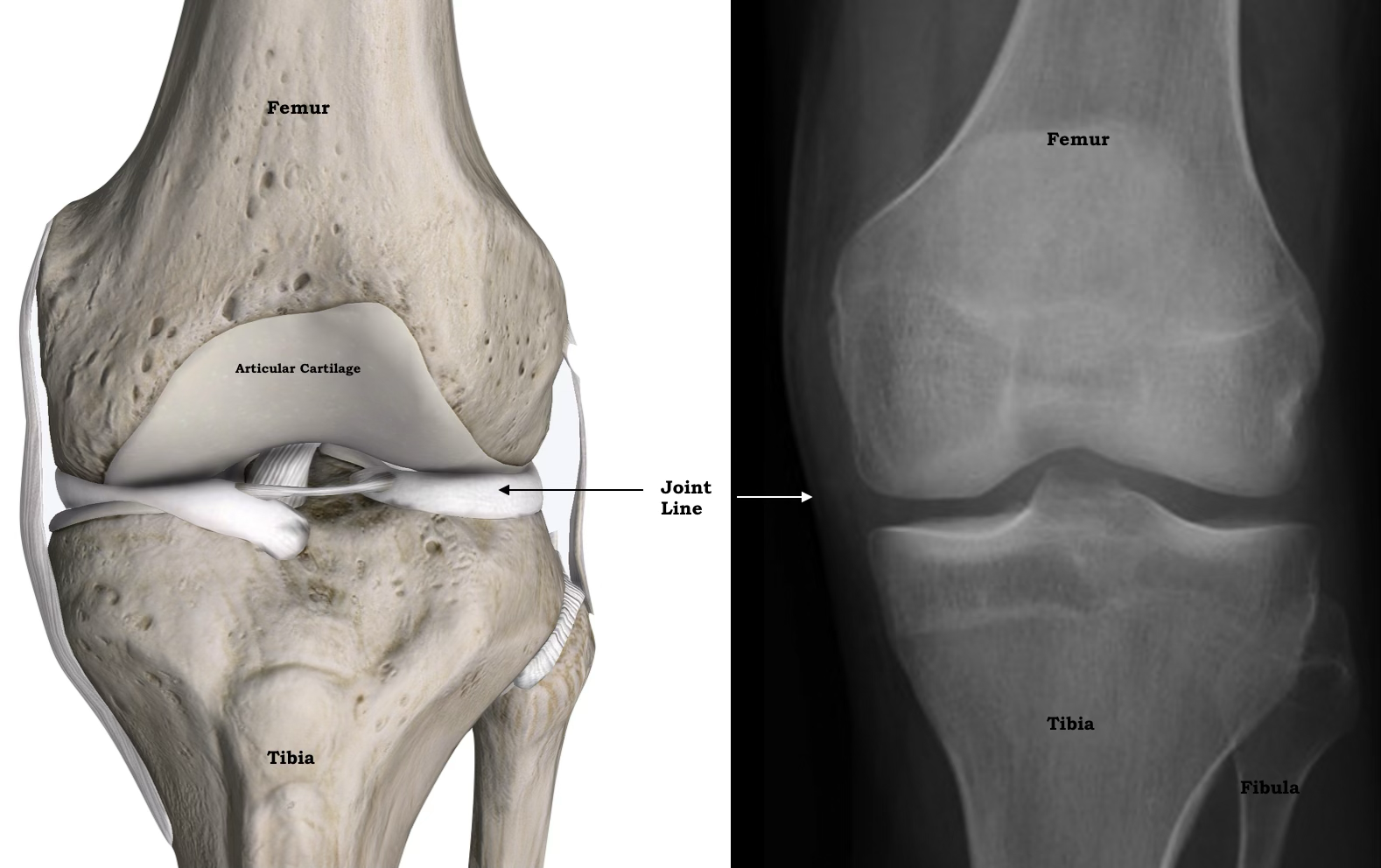
Every joint is two bones that need to glide on each other. Covering each bone is a thin layer of cartilage — only a few millimeters thick — that is extremely smooth. That smooth surface lets the joint move with very little friction.
With age or injury the cartilage wears away. Bare bone is rough. Rough bone rubbing on rough bone causes inflammation, swelling, and pain. That is arthritis. Cartilage cannot grow back. Treatment is about calming inflammation.
How we diagnose it
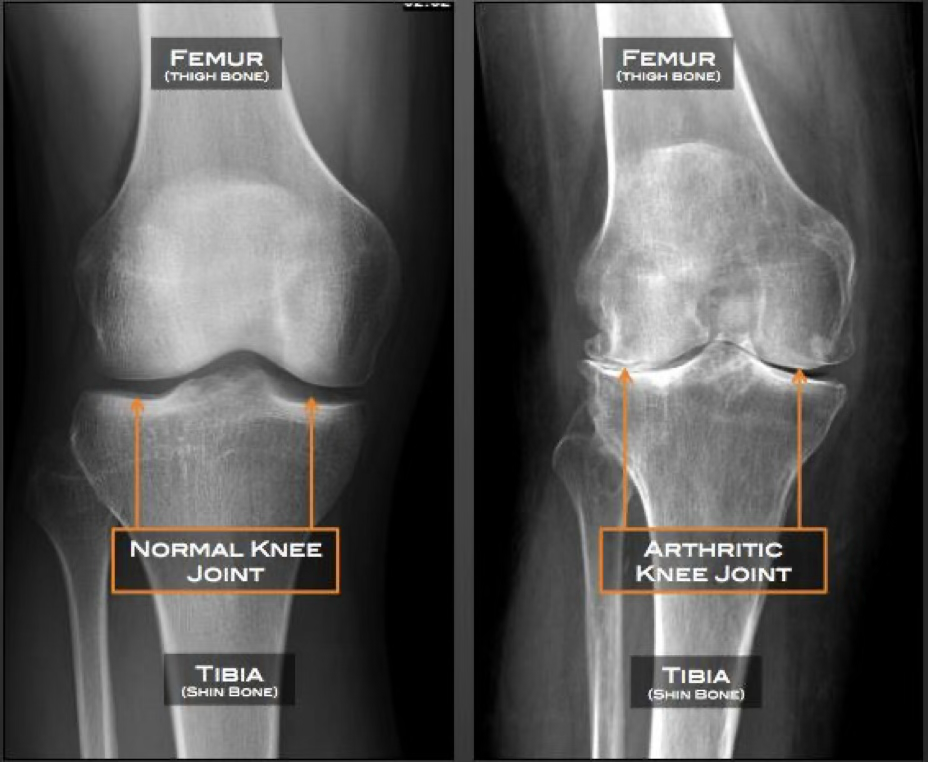
X-ray is the main test for osteoarthritis. Cartilage itself does not show on X-ray and is poorly seen on MRI. We look for the space between the bones — that space is where healthy cartilage should be.
On X-ray
Arthritis on X-ray is loss of space between the bones — the cartilage is gone. Extra signs can include bone spurs, sclerosis (the bone looking extra white and hard), subluxation, and deformity.
If the space is preserved, the cartilage is likely still there.
About MRI
MRI is useful for evaluating the meniscus, muscles, and tendons. It does not show bone as clearly, and it is a poor test for the cartilage surface itself.
For osteoarthritis, an office X-ray is usually enough. MRI or arthroscopy is sometimes used when the picture is still unclear.
Total vs. partial
The knee has three compartments. Which operation fits depends on how many of them are worn and whether the ACL is intact.
Partial
A partial knee replacement resurfaces only one compartment and preserves the ACL and PCL. Recovery is typically about six weeks, and many people say the knee feels more natural.
It may be an option when arthritis is limited to one compartment and the ACL is intact. An X-ray is usually enough to decide. Sometimes an MRI or arthroscopy is used to confirm the other compartments and the ACL.
Conversion of a partial to a total is uncommon, but the untreated compartments can still wear over time.
Total
A total knee replacement resurfaces all three compartments: the inner (medial), outer (lateral), and the surface behind the kneecap (patellofemoral). The ACL and PCL are not preserved. Recovery is typically about twelve weeks.
Arthritis in those compartments is addressed with the implant. If more than one compartment is involved, a total is usually the better fit. That decision is made together in clinic.
What the surgery actually is
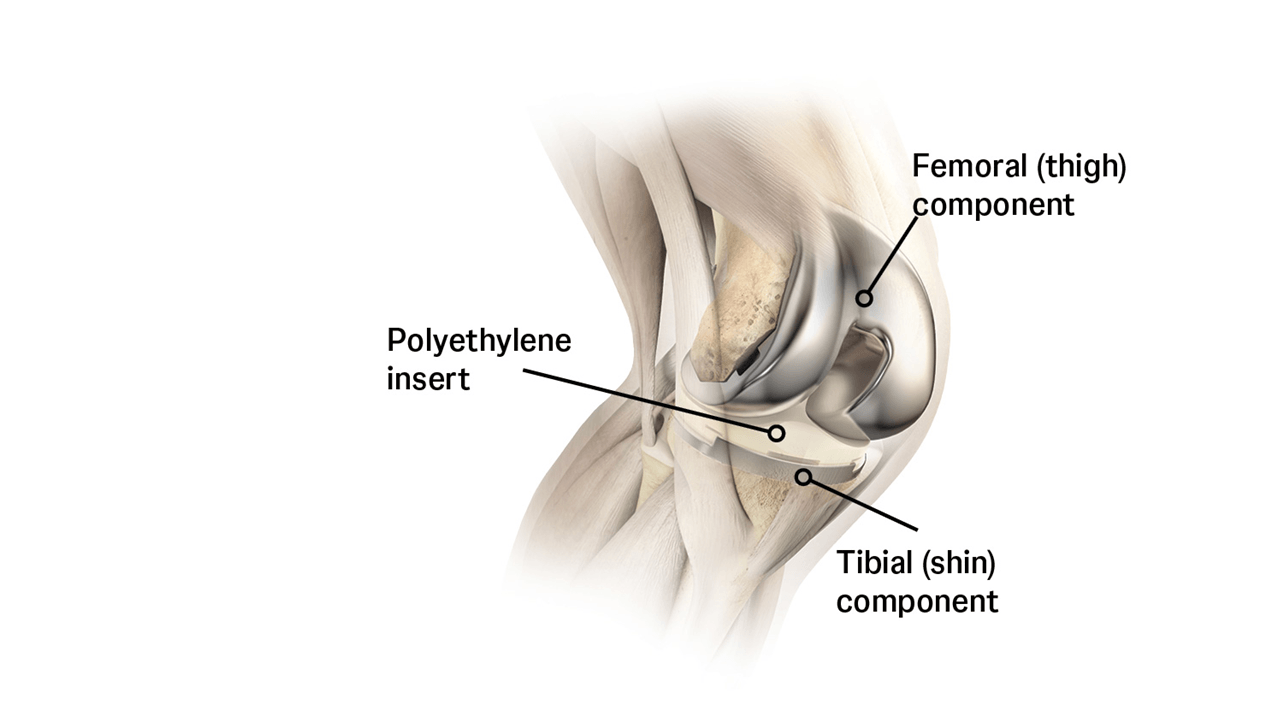
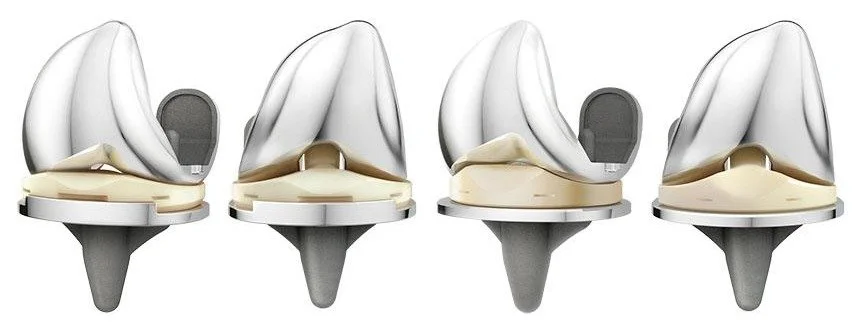
People sometimes imagine the end of the femur being removed and replaced with metal. That is not what happens. About 9 mm of bone is trimmed from the femur and about 4 mm from the tibia so smooth metal components can sit on the bone ends.
Those metal surfaces glide against a polished plastic (polyethylene) insert. Less friction usually means less pain and better motion.
Dr. Ward uses the DePuy Attune knee system — metal on the femur and tibia with a highly cross-linked polyethylene spacer.
Scheduling and Dr. Ward's approach
You can schedule surgery in clinic with Dr. Ward, or call the office after your visit. Leave a message if needed. Dr. Ward or a physician assistant will see you before surgery to answer any remaining questions.
Dates and hospital
Alison Guerra, the surgery scheduler, will call with available dates for you to choose from. Surgery is performed at Oro Valley Hospital or Northwest Medical Center, based on your preference.
Insurance
A total knee is elective, but it is generally considered medically necessary after non-operative care has failed. Our office handles insurance pre-approval. Call your plan for details on your deductible and expected out-of-pocket costs.
“Jiffy Knee” is marketing language for a quadriceps-sparing surgical approach, not a special implant. The standard exposure splits the quad tendon and gives a clearer view; midvastus and subvastus approaches spare that tendon. All three techniques have been used for years. When anatomy allows, quadriceps-sparing is Dr. Ward’s standard approach — you do not need to ask for it.
What to expect
Before
You will have a preoperative visit to review labs, discuss questions, plan pain control, and arrange a physical therapy referral. Hospital testing can usually be done without an appointment. Do not eat anything after midnight the night before surgery.
Day of
Surgery typically lasts 60–90 minutes. Dr. Ward generally recommends a nerve block and a spinal anesthetic, and he also injects the knee. Many people go home the same day after 2–4 hours in phase-two recovery. He calls the person you designate when surgery is finished.
Recovery
Physical therapy usually starts about 7–10 days after surgery, or sooner if you prefer. Packet goals are about 5° to 115° by six weeks and 0° to 125° by twelve weeks. Getting the knee fully straight matters as much as getting it to bend.
Before surgery
Most of the work happens before the operating room. Write questions down. Bring them to the preoperative visit.
Pre-op visit
- Labs and leftover questions
- Pain plan
- Physical therapy referral
- Walker prescription if you need one — most people borrow a walker or pick one up at a thrift store
Testing
No appointment is needed at Oro Valley Hospital or Northwest Hospital for:
- CBC, BMP, PT/INR
- Chest X-ray
- EKG
Medical clearance from your PCP is needed if you have lung, heart, or kidney problems. It is not needed for cholesterol or stable high blood pressure. If you see a cardiologist, anesthesia requires cardiology clearance as well.
Medications
- Stop aspirin 7 days before surgery
- Blood thinners are stopped only with guidance from your PCP or cardiologist (often about 3 days)
- Restart them the evening of the day after surgery unless you are told otherwise
Night before and morning of
- Nothing to eat after midnight. Eating means the case is canceled.
- A sip of water only for morning heart medications
- Shower the morning of surgery with regular over-the-counter soap. No special soap is needed.
- Stop lotion on the legs the day before
- Do not blade-shave the legs for 2 days. Clippers are fine the day before.
Prehab
Bike, elliptical, and water exercise are good. No impact. The goal is to build the thigh muscles before surgery.
Physical therapy starts about 7–10 days after surgery, sooner if you want.
Home setup
- Clear rugs and cords
- Sit with the knee fully straight. Do not place a pillow under the knee. A recliner is fine only if the knee can stay completely straight.
- A straight knee is needed to walk without a limp
- Stairs: up with the good leg, down with the surgical leg
Day of surgery
Bring
- Comfortable clothes and shoes
- Phone, ID, and insurance card
- A ride home
- Glasses (no contacts)
- Dentures, if you wear them (you will remove them for surgery)
Leave at home
- Walker — have it waiting at home
- Ice machine
- Jewelry and rings
- Home medications
- Makeup
Anesthesia
A loved one can be with you in pre-op. Dr. Ward and anesthesia meet you there.
Anesthesia is usually a nerve block plus a spinal (similar to an epidural) so you wake up with less pain and less nausea. Dr. Ward also injects medication into the knee. If you have significant back arthritis or prior back surgery, a spinal may not be possible.
Timing
- About 15–20 minutes to go to sleep
- Surgery 60–90 minutes
- Recovery room about 45–60 minutes. Dr. Ward calls the person you designate right afterward.
- Phase two lasts 2–4 hours: you get up with the nurses and physical therapy, then go home. An overnight stay is arranged if needed.
Incision and dressings
The incision runs from two fingerbreadths above the kneecap down to the tibial tubercle. Absorbable sutures are under the skin. Nothing to remove.
- Ace wrap for 2 days for swelling
- Mepilex adhesive for 7 days — keep it dry
- Prineo mesh is glued on for about 2–3 weeks. Showers are fine. No soaking. Trim it as it peels.
Recovery
Stay ahead of the pain for the first three days. Sharp pain eases after 1–2 weeks. A night ache like a toothache is common around six weeks.
Pain, ice, swelling
- Ice 45 minutes on, then 15 minutes off, while you are resting
- Elevate foot above knee above hip
- Ankle pumps
- Bruising down to the ankle and swelling in the foot are common
Blood clots
Blood clots are uncommon, but the risk is higher after knee replacement. Movement is the best prevention. You will be on a blood thinner for a period as directed in clinic.
Physical therapy
Plan on about three months of physical therapy. Getting the knee fully straight is as important as getting it to bend. A straight knee is what lets you walk without a limp.
Driving
Not while you are on narcotics.
- Left knee: often sooner, if you have been off narcotics for 4 hours
- Right knee: off the walker, full weight, and able to slam the brake
Work
- Desk work: minimum about 2 weeks. Most people are more comfortable at 4.
- Standing jobs: minimum about 4 weeks. Most people need 6.
The other knee
If the other knee also needs surgery, wait until about the 3-month mark.
Common questions
These answers come from the packet. If something still does not make sense, come in. You are not wasting anyone’s time.
Why does the knee click?
That is metal on plastic. It is normal. It usually quiets down as scar tissue forms.
Why is the outside of the knee numb?
A midline incision cuts the infrapatellar branch of the saphenous nerve. That numbness is expected. It may shrink over time, or it may be permanent. It is not a strength problem.
Why is it so tight and swollen?
That is usually worst in the first two weeks. Ice, elevate, use anti-inflammatories as prescribed, and use compression if you can tolerate it.
It feels warm and a little red.
Extra blood flow can make the knee feel warm and look a little red for up to about three months. That can be normal healing.
There is a pimple on the incision.
That is often a suture abscess. It does not usually need antibiotics. It can pop like a pimple, or you can show Dr. Ward.
I see a fishing-wire suture.
That is suture spitting. You can clip it or leave it.
Will I set off airport scanners?
Many newer scanners do not set it off, but every airport is different. You do not need a card, and you do not have to show the scar.
Other joints hurt.
You are often favoring the surgical side. That usually settles as your gait normalizes.
My leg feels longer.
That is usually because a bow-leg or knock-knee was corrected to straight, not because length was added. About 9 mm is taken from the femur and 3–4 mm from the tibia, and the same amount is replaced.
Do I need antibiotics for the dentist?
Take antibiotics before invasive dental work that may cause bleeding. They are not needed for a routine cleaning. Call the office if you are unsure.
Compression stockings?
Optional. Skip them if they are too tight or hard to put on.
When should I worry?
Infection can look like normal healing. Come in rather than wait. You are not wasting anyone’s time by being cautious.
Related resources
The packet covers the details: preparing for surgery, the day of, motion goals, and week-by-week recovery. This page is the short version. The PDF is the full one.
Read the packet (PDF) Total and Partial Knee Replacement Post-Op Instructions (PDF) Complete post-op packet (instructions + exercises + worksheet, 28 pages, best for printing)Pre-op conditioning
Preparing your muscles before total knee replacement can make recovery easier. Download the home therapy program for before hip or knee replacement.
Schedule a visit
Call 520-881-1394 and we will find a time that works.
Call 520-881-1394