
Rotator Cuff Repair
Arthroscopic repair of a torn rotator cuff tendon using Arthrex SwiveLock suture anchors — plus how we diagnose it, what surgery involves, and how recovery is paced over the first six months.
Call 520-881-1394Who this is for
This page is for people whose rotator cuff tear is causing pain or limiting how they use the arm, especially after rest, medications, physical therapy, or injections have not been enough.
Not every tear needs surgery. Some improve with non-operative care. Others stay painful or weak enough that repair is the better next step. Dr. Ward and his physician assistants, Olivia Sobojinski, PA, and Gabby Ventura, PA, review the exam and imaging with you and decide together.
What happens at your visit
You will have a focused shoulder exam. Many patients already have an MRI, or one is ordered to show tear size and location. We talk through repair versus continued non-operative care and a timeline that fits your life.
If you decide to schedule surgery later, you can do that in clinic with Dr. Ward, or call the office after your visit.
Understanding the rotator cuff
The rotator cuff is a group of tendons that help raise and rotate the arm and keep the ball centered in the socket (see number 4 on the figure). A tear can happen from an injury or from wear over time. When the tendon is detached from bone, the shoulder can hurt with reach, weaken with lifting, and disturb sleep.
Treatment often starts with rest from aggravating activity, medications, physical therapy, and sometimes an injection. If symptoms persist and the tear is repairable, arthroscopic repair can reattach the tendon so it has a chance to heal back to bone.
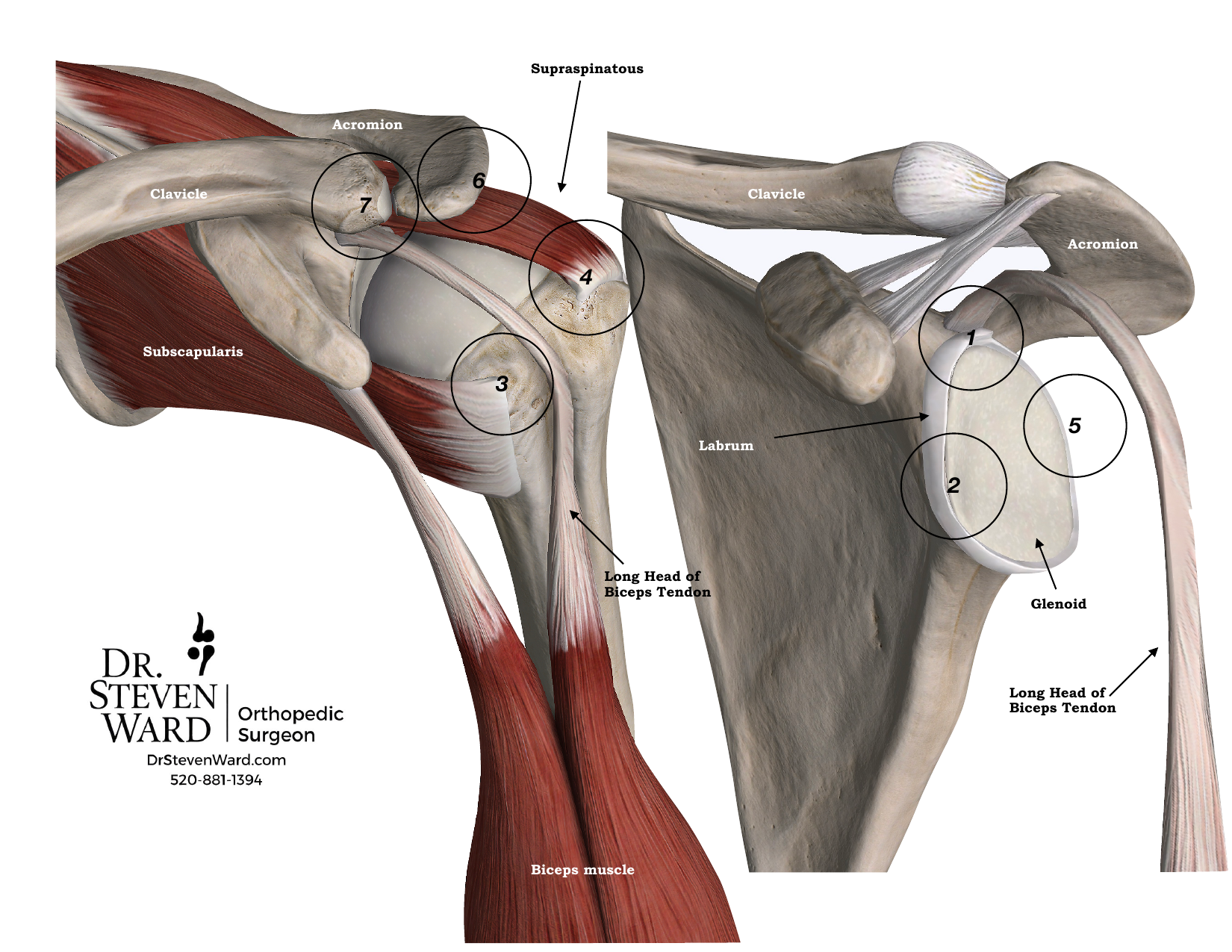
What the numbers mean
The numbered spots on the anatomy figure are common places we talk about in clinic. Number 4 is the classic rotator cuff footprint (supraspinatus / infraspinatus). The others matter when pain or instability involves the labrum, biceps, subacromial space, or AC joint.
1 — Superior labrum / biceps anchor
Where the long head of the biceps attaches to the top of the labrum. Injury here can cause a SLAP tear. Treatment may be repair when appropriate, or more often a biceps tenodesis (reattaching the biceps in another location).
2 — Anterior labrum
Helps keep the shoulder from dislocating forward. Damage can cause pain and a sense of instability. Partial tears may be debrided; more significant tears may need anchor repair.
3 — Subscapularis / biceps sling
The upper edge of the subscapularis (the rotator cuff muscle for internal rotation) and where the biceps exits the joint. Problems here can cause front-of-shoulder pain and weakness with internal rotation. Tears are repaired when needed.
4 — Supraspinatus / infraspinatus
The area most people mean by “rotator cuff.” These tendons help elevate the arm. High-grade partial tears and full-thickness tears are often repaired to relieve pain and restore strength.
5 — Posterior labrum / cartilage
The back of the labrum helps prevent backward dislocation. This view also shows the joint cartilage; damage there is arthritis.
6 — Subacromial space
The space between the acromion and the rotator cuff. A bone spur here can rub the cuff and contribute to damage. When a spur is present, decompression is often part of treatment.
7 — Acromioclavicular (AC) joint
Where the collarbone meets the acromion. Arthritis here is common. When it is the pain generator, a distal clavicle resection (shaving the worn end of the collarbone) can help.
How we diagnose it
Diagnosis starts with the history and a careful exam. X-rays help rule out arthritis and other bone problems. An MRI is often used to see tear size, which tendons are involved, and how far the tendon has retracted — details that matter for repair planning.
Exam
We check strength, motion, and which movements recreate your pain. Impingement and cuff weakness patterns help narrow which tendons are involved.
Imaging
X-ray shows bone and joint space. MRI shows soft tissue: tear location, size, and quality of the remaining tendon. Those findings guide whether repair is likely to help.
What the surgery actually is
Rotator cuff repair is usually done arthroscopically through small incisions. A camera and instruments go into the shoulder so the torn tendon can be cleaned, positioned, and reattached to bone.
Dr. Ward uses Arthrex SwiveLock suture anchors. The anchors sit in the bone and hold high-strength suture that presses the tendon back against its footprint. That contact is what allows the tendon to heal over the weeks that follow — which is why the sling and early motion limits matter.
Scheduling
You can schedule surgery in clinic with Dr. Ward, or call the office after your visit. Leave a message if needed. Preoperative instructions are reviewed in clinic before the day of surgery so you know what to bring, what to stop, and when to arrive.
Dr. Ward or a physician assistant will see you before surgery to answer remaining questions. Write them down and bring them to that visit.
What to expect
Before
You will have a preoperative visit to review questions, plan pain control, and arrange a physical therapy referral. The office gives day-of instructions in clinic. Do not eat after midnight the night before surgery unless you are told otherwise.
Day of
Bring comfortable clothes, ID, insurance card, and a ride home. Dr. Ward and anesthesia meet you in pre-op. A nerve block is often discussed so the shoulder is numb when you wake up; anesthesia helps decide what is best for you. Most people go home the same day after time in the recovery room. He calls the person you designate when surgery is finished.
Recovery
Physical therapy starts the week after surgery. Wear the sling when you are up and moving for six weeks so the repair can heal. Motion goals expand in weeks 7–12. Strengthening builds through months 3–6, with return to sport often around six months when criteria are met.
Recovery phases
These timelines come from Dr. Ward’s rotator cuff rehab protocol. Your therapist may adjust details based on how the repair and your motion progress.
Healing phase (weeks 1–6)
Goals: control pain and swelling, allow the repair to heal, keep the elbow and hand moving, and begin shoulder passive range of motion.
- Clinic: about 2 weeks and 6 weeks after surgery
- PT: starts the week after surgery, typically 2–3 times per week
- Sling: wear when up and moving and around people; may remove to rest in a chair or on the couch, to sleep, and for eating, reading, typing, or gentle in-front activities without extending the arm
- Week 4: sling mainly when leaving the house or in public
- Week 6: stop the sling permanently
- Precautions: no lifting more than 10 lbs; no ladder or step stool; no arm above shoulder height
- Motion weeks 1–2: pendulum; assisted forward flexion and abduction to 90°
- Motion weeks 3–6: assisted motion to 120°; supine forward flexion with a rod (touchdown); recumbent bike is okay
Wound care & pain (healing phase)
- Leave the dressing 3 days, then band-aids; reapply a dressing if there is drainage until dry
- Keep the incision dry until day 7, then shower; do not submerge until day 30
- Leave steri-strips until they fall off, or remove at 14 days
- Gentle scar massage at 2 weeks; no lotion on the incision until day 30
- Days 1–3: take pain medication on a schedule
- Days 3–14: taper narcotics; keep NSAID and Tylenol scheduled; narcotic at night and after PT as needed
- Day 14+: narcotic only at night if needed; Tylenol as needed; NSAID scheduled until week 6
- Ice: 45 minutes on / 15 off during weeks 1–2, then 3 times a day or as needed for pain
- Soft tissue massage may begin at week 2; trigger-point work for spine, scapula, and forearm as directed
Motion phase (weeks 7–12)
Goals: forward flexion and abduction toward 160°, external rotation about 25°, internal rotation to the lower back; pain-free daily activities; work toward resistance training near week 12.
- Clinic: about 6 weeks and 12 weeks after surgery
- PT: typically 1–2 times per week depending on progress
- No fixed weight limit, but progress gradually; caution with overhead work and ladders
- Scapular strengthening (retractors and upward rotators)
- Weeks 11–12: begin strengthening as motion normalizes — high reps / low loads first
- Cardio: recumbent bike; elliptical without push/pull; treadmill walking; jogging later if ready
- Narcotics are generally not required in this phase
Strengthening phase (months 3–6)
Goals: full range of motion compared with the other side, full social and occupational activity, and preparation for return to sport around six months.
- Clinic: about 12 weeks, then as needed
- Work toward discharge from PT while continuing home exercises
- Avoid contact sports until closer to six months or until physical therapy releases you
- Advance motion and strength toward the demands of work and the activities you enjoy
- Discharge when: full pain-free motion versus the other side and full return to social and occupational activities
Common questions
These answers come from the rehab protocol and the usual questions patients ask. If something still does not make sense, call the office or come in.
When do I stop wearing the sling?
Wear it when you are up and moving and around people for the first six weeks. At week 4 you may wear it mainly when leaving the house or in public. Stop wearing it permanently at week 6.
When can I shower?
Keep the incision dry until day 7, then you may shower. Do not submerge the shoulder under water until day 30.
How much can I lift in the first six weeks?
No lifting more than 10 pounds. Do not climb a ladder or step stool, and do not raise the arm above shoulder height during the healing phase.
When does physical therapy start?
The week after surgery. In the healing phase you typically go 2–3 times per week. In the motion phase that often becomes 1–2 times per week depending on progress.
When does strengthening begin?
As range of motion normalizes, usually around weeks 11–12, starting with high repetitions and low loads. Heavier strengthening continues through months 3–6.
When can I return to contact sports?
Avoid contact sports until closer to six months after surgery, or until physical therapy releases you. Return to sport is often planned around the six-month mark when motion and strength goals are met.
What about the dressing and steri-strips?
Leave the dressing three days, then switch to band-aids. Leave white steri-strips until they fall off, or remove them at 14 days. Gentle scar massage may begin at two weeks. Do not put lotion on the incision until day 30.
How should I use ice after surgery?
Weeks 1–2: keep ice on the shoulder for 45 minutes, then remove it for 15 minutes. After weeks 1–2, reduce to 3 times a day or as needed for pain. Later, ice after therapy as needed.
Related resources
Shoulder Arthroscopy Post-Op Instructions (PDF) Rotator Cuff Repair Post-Op Instructions (PDF) Rotator Cuff Tear Handout (PDF) Total shoulder replacement Physical therapy locations Exercises Surgical services OrthoInfo.orgSchedule a visit
Call 520-881-1394 and we will find a time that works.
Call 520-881-1394