
ACL Reconstruction
Rebuilding a torn anterior cruciate ligament with Arthrex TightRope fixation — plus how we choose a graft, what surgery involves, and how recovery is paced from the first brace weeks through return to sport.
Call 520-881-1394Who this is for
This page is for people whose ACL tear is causing instability, giving-way, or limiting the sports and activities they want to return to — especially when bracing, physical therapy, or activity modification have not been enough.
Not every ACL tear needs surgery. Some people do well with non-operative care. Others stay unstable enough that reconstruction is the better next step. Dr. Ward and his physician assistants, Olivia Sobojinski, PA, and Gabby Ventura, PA, review the exam and imaging with you and decide together.
What happens at your visit
You will have a focused knee exam. Many patients already have an MRI, or one is ordered to confirm the ACL tear and look for meniscus or cartilage injury. We talk through reconstruction versus continued non-operative care, graft options, and a timeline that fits your life and sport.
If you decide to schedule surgery later, you can do that in clinic with Dr. Ward, or call the office after your visit.
Understanding the ACL
The anterior cruciate ligament (see number 3 on the figure) runs through the center of the knee and helps keep the shin from sliding forward on the thigh bone. It also helps control pivot and cutting motions that matter in sports.
An ACL tear often happens with a sudden twist, landing, or change of direction. People commonly feel a pop, then swelling, and later a sense that the knee gives way or feels unstable with cutting or pivoting. Treatment may start with bracing and physical therapy. When instability persists or you want to return to high-demand sport, arthroscopic ACL reconstruction replaces the torn ligament with a graft and fixes it with cortical buttons (Arthrex TightRope) so it can heal into bone tunnels.
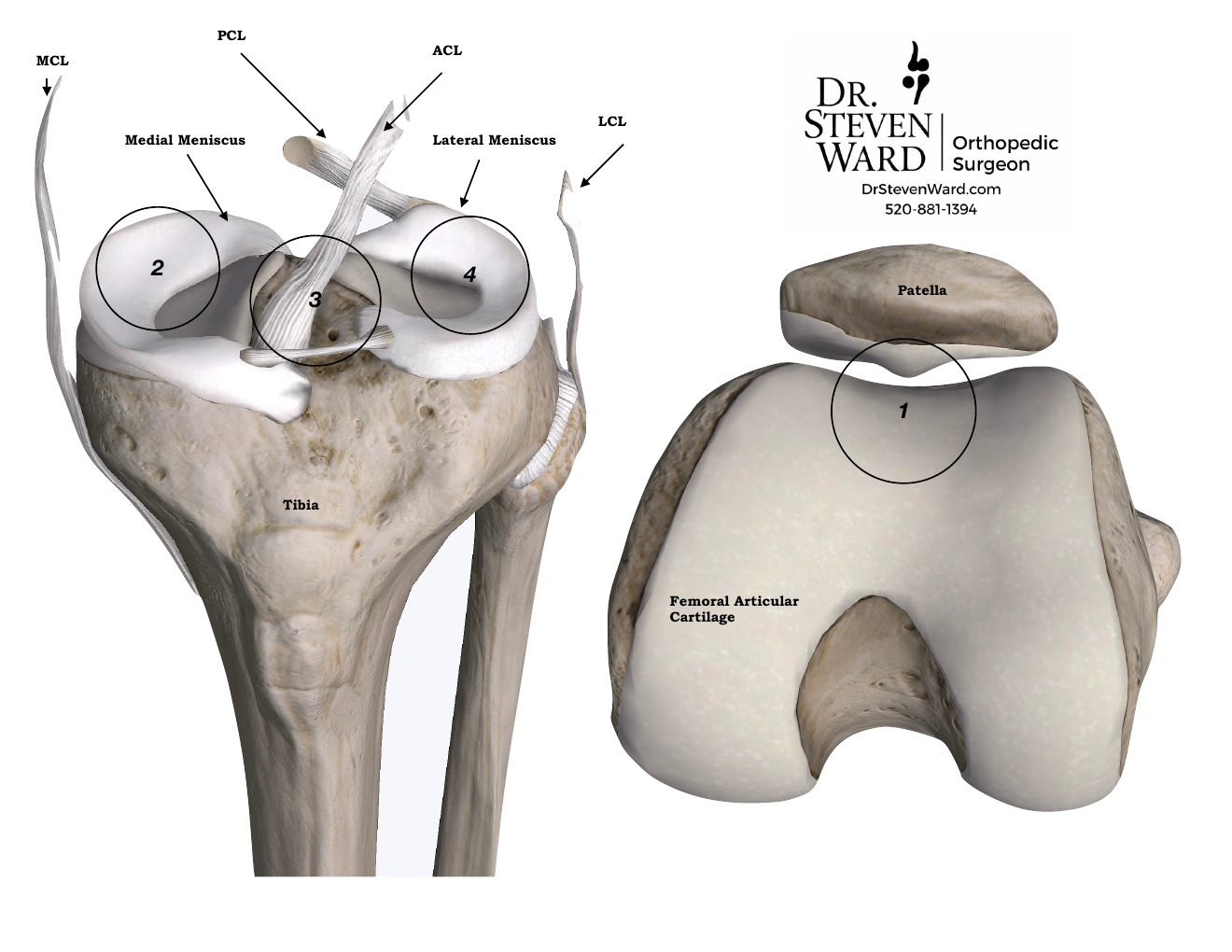
What the numbers mean
The numbered spots on the anatomy figure are common places we talk about in clinic. Number 3 is the ACL — the ligament reconstructed on this page. The menisci and kneecap joint often matter when planning surgery and rehab.
1 — Patellofemoral joint
Where the kneecap meets the femur. Front-of-knee pain can come from cartilage wear or tracking issues. Graft harvest (especially patellar tendon) can temporarily increase front-of-knee symptoms, which therapy helps manage.
2 — Medial joint space / meniscus
Contains the medial meniscus and medial cartilage. ACL tears often occur with a meniscus tear. Repair versus resection changes early weight-bearing and brace rules.
3 — ACL
The anterior cruciate ligament stabilizes the knee against forward tibial translation and pivot. Tears cause instability or giving-way. Reconstruction uses autograft or allograft fixed with Arthrex TightRope cortical buttons.
4 — Lateral joint space / meniscus
Contains the lateral meniscus and lateral cartilage. Lateral meniscus injury can accompany ACL tears; treatment follows the same repair-or-resect principles and may alter early motion limits.
How we diagnose it
Diagnosis starts with the history and a careful exam. X-rays help rule out fracture and other bone problems. An MRI is often used to confirm the ACL tear and to look at the menisci, cartilage, and other ligaments that matter for planning.
Exam
We check swelling, motion, and stability tests that recreate a sense of give-way or pivot. Those patterns help confirm whether the ACL is the main driver of your symptoms.
Imaging
X-ray shows bone and joint space. MRI shows soft tissue: ACL fiber disruption, associated meniscus tears, and cartilage status. Those findings guide graft choice, concurrent procedures, and rehab precautions.
Graft choice
Dr. Ward usually prefers an age-based starting point, then individualizes in clinic based on your sport, activity level, prior surgery, and anatomy.
Under 25 — Patellar tendon (BTB) autograft
For most patients younger than 25, Dr. Ward commonly uses a bone–patellar tendon–bone (BTB) autograft taken from your own knee. The bone plugs at each end of the graft help it heal securely in the tunnels.
BTB is a strong option for athletes returning to cutting and pivoting sports. Front-of-knee soreness at the harvest site is possible early on and is addressed in therapy.
25 and older — Allograft
For most patients 25 and older, Dr. Ward generally prefers an allograft (donor tissue). That avoids a harvest site on your own knee and can mean less early donor-site pain while still providing a reliable graft for reconstruction.
Allograft choice and processing are reviewed in clinic so you understand the plan before surgery.
Age is a useful guide, not a rigid rule. Activity demands, prior ACL surgery, meniscus repair, and personal preference all matter. Dr. Ward, Olivia Sobojinski, PA, or Gabby Ventura, PA will walk through options with you so the graft fits your goals.
Fixation: Arthrex TightRope
Once the graft is in the bone tunnels, it is secured with Arthrex TightRope cortical fixation — small buttons that sit on the cortex and tension the graft for healing.

TightRope cortical buttons
Buttons rest on the outer cortex of the femur and tibia. Adjustable loop suture allows controlled tensioning of the graft after it is seated in the tunnels.

BTB TightRope
Designed for patellar tendon (BTB) autograft reconstruction, matching the bone plugs used in younger patients.

Soft-tissue / RT TightRope
Used when the graft is soft tissue (including many allograft constructs), with the same cortical-button tensioning concept.
What the surgery actually is
ACL reconstruction is done arthroscopically through small portal incisions. A camera and instruments go into the knee so Dr. Ward can confirm the tear, address meniscus or cartilage findings when needed, and prepare bone tunnels in the femur and tibia.
The chosen graft is passed through the tunnels and fixed with Arthrex TightRope buttons on the cortex. The buttons allow controlled tensioning so the graft sits securely while it heals into bone over the months that follow — which is why the brace, early motion limits, and physical therapy matter.
Scheduling
You can schedule surgery in clinic with Dr. Ward, or call the office after your visit. Leave a message if needed. Preoperative instructions are reviewed in clinic before the day of surgery so you know what to bring, what to stop, and when to arrive.
Dr. Ward or a physician assistant will see you before surgery to answer remaining questions. Write them down and bring them to that visit.
What to expect
Before
You will have a preoperative visit to review questions, plan pain control, and arrange a physical therapy referral. The office gives day-of instructions in clinic. Do not eat after midnight the night before surgery unless you are told otherwise.
Day of
Bring comfortable clothes, ID, insurance card, and a ride home. Dr. Ward and anesthesia meet you in pre-op. Anesthesia discusses the plan that is best for you. Most people go home the same day after time in the recovery room. He calls the person you designate when surgery is finished.
Recovery
Physical therapy starts the week after surgery. The brace stays locked in extension for about two weeks until you can do a straight leg raise without lag. Motion and strength build through weeks 7–12. Jogging progresses in months 4–6; contact sports are typically held until about six months.
Recovery phases
These timelines come from Dr. Ward’s ACL reconstruction rehab protocol. Your therapist may adjust details based on graft type, meniscus repair, and how your motion progresses.
Healing phase (weeks 1–6)
Goals: control pain and swelling, allow the graft to heal, begin range of motion from 0–90°, and regain quadriceps control (eliminate extensor lag).
- Clinic: about 2 weeks and 6 weeks after surgery
- PT: starts the week after surgery, typically 2–3 times per week
- Crutches: use for assistance weeks 1–2, then wean (unless meniscus was repaired)
- Brace: wear when up and moving; may remove to sleep or rest. Locked in extension for the first two weeks (unlock when sitting or resting). Unlock permanently once you can do a straight leg raise and keep the leg straight the entire time
- If meniscus repaired: partial weight-bearing at week 4 with brace locked in extension; do not flex beyond 90° for 6 weeks
- Precautions: no lifting more than 20 lbs; no ladder or step stool
- Ice: 30 minutes on / 20 off every other hour while awake for weeks 1–2, then about 3 times per day
- Exercises weeks 1–2: calf pumps; assisted heel slides 0–90°; straight leg strengthening; supine passive stretch with towel under heel
- Exercises weeks 3–4: progress prior exercises; short-arc quad extensions (may add weights); seated ankle ROM and proprioception; gait training; upper body OK
- Exercises weeks 5–6: leg press 0–60°; hip extension endurance; stationary bike 0–100°; pool walking (no swimming or kicking)
Wound care & pain (healing phase)
- Leave the dressing 3 days, then band-aids; reapply a dressing if there is drainage until dry
- Keep the incision dry until day 7, then shower; do not submerge until day 30
- Leave steri-strips until they fall off, or remove at 14 days
- Gentle scar massage at 2 weeks; no lotion on the incision until day 30
- Days 1–3: take pain medication on a schedule
- Days 3–14: taper narcotics; keep NSAID and Tylenol scheduled; narcotic at night and after PT as needed
- Day 14+: narcotic only at night if needed; Tylenol as needed; NSAID scheduled until week 6
- Soft tissue massage may begin at week 2; trigger-point work for hip, thigh, and lower leg as directed
Motion & strengthening (weeks 7–12)
Goals: control pain and swelling, progress range of motion beyond 90° toward full motion, and strengthen the quadriceps.
- Clinic: about 6 weeks and 12 weeks after surgery
- PT: typically 1–2 times per week depending on progress
- Wound: may submerge if incisions are fully healed; deep scar massage; Vitamin E lotion OK
- Crutches: wean to full weight-bearing (full weight with assist → one crutch → off)
- Brace: discontinue
- Precautions: no running
- Ice: when the knee is swollen; soft tissue massage continues
- Pain: Tylenol at night and before therapy as needed; NSAID; narcotics generally not required
- Weeks 7–8: stationary bike; gait training; general lower stretching; progressive LE strengthening with emphasis on quad extension
- Weeks 9–10: progressive neuromuscular training; may begin resistance training
- Weeks 11–12: bike, elliptical, stairmaster; full swimming OK
Return to sport (months 4–6)
Goals: jog at your own pace and distance without pain, gain equal strength with the other leg, and return to full occupational requirements.
- Clinic: about 12 weeks, then as needed
- Graduate from formal PT while continuing home exercises
- Precautions: no contact sports until 6 months
- Month 4: non-impact aerobic conditioning; lower extremity stretching; progressive strengthening (lunges, leg press, calf press, squats to 90°, hamstring curls, hip work); balance, agility, and plyometrics as directed
- Months 5–6: continue month-4 work; progressive jogging program (increase about 10–20% each week)
- Discharge when: running without pain, able to hop on one leg, full return to occupational and recreational activity, and equal lower-leg strength
Common questions
These answers come from the rehab protocol and the usual questions patients ask. If something still does not make sense, call the office or come in.
How long is the brace locked in extension?
About two weeks. The brace is locked in extension while you are up and moving. You can unlock it when sitting or resting. It can be unlocked permanently once you can do a straight leg raise and keep the leg straight the entire time. The brace is discontinued in the motion phase (weeks 7–12).
When does physical therapy start?
The week after surgery. In the healing phase you typically go 2–3 times per week. In weeks 7–12 that often becomes 1–2 times per week depending on progress.
When can I shower?
Keep the incision dry until day 7, then you may shower. Do not submerge the knee under water until day 30. In weeks 7–12 you may submerge if the incisions are completely healed.
How much can I lift in the first six weeks?
No lifting more than 20 pounds. Do not climb a ladder or step stool during the healing phase.
What if my meniscus was also repaired?
Partial weight-bearing begins at week 4 with the brace locked in extension. Do not flex the knee beyond 90° for six weeks. Crutch and brace rules differ from ACL-only reconstruction — your therapist will follow the combined protocol.
Which graft will I get?
Dr. Ward commonly uses patellar tendon (BTB) autograft for patients under 25 and allograft for patients 25 and older. Final choice is individualized in clinic based on sport, activity, prior surgery, and preference.
When can I return to contact sports?
No contact sports until six months after surgery. Jogging typically progresses in months 4–6 once strength and motion goals are on track.
What about the dressing and steri-strips?
Leave the dressing three days, then switch to band-aids. Leave white steri-strips until they fall off, or remove them at 14 days. Gentle scar massage may begin at two weeks. Do not put lotion on the incision until day 30.
Related resources
Total knee replacement Knee arthroscopy Physical therapy locations Exercises OrthoInfo.orgSchedule a visit
Call 520-881-1394 and we will find a time that works.
Call 520-881-13946130 N. La Cholla Blvd, Suite 135A
Tucson, AZ 85741 · (520) 881-1394
1521 E. Tangerine Rd, Suite 337
Oro Valley, AZ 85755 · (520) 901-6380