
Proximal Humerus Fracture
A break at the top of the arm bone — the ball of the shoulder. Most heal with a sling and guided therapy; when pieces are displaced or complex, we may recommend plate fixation or a reverse shoulder with the DePuy INHANCE system.
Call 520-881-1394 Physical therapy locationsWho this is for
This page is for people who have broken the proximal humerus — the upper end of the arm bone that forms the ball of the shoulder. These injuries are common after a fall, especially in older adults with thinner bone, and can also follow higher-energy trauma in younger, active people.
Dr. Steven Ward and his physician assistants, Olivia Sobojinski, PA, and Gabby Ventura, PA, review your exam and imaging with you. Treatment is not one-size-fits-all. Age, bone quality, how far the pieces have moved, your health, and what you need the shoulder to do all matter.
What happens at your visit
We start with a focused shoulder exam and review X-rays. Sometimes a CT scan is ordered for more detail when the pattern is complex or surgery is being planned. We talk through non-operative care, plate fixation (ORIF), and reverse total shoulder when those options apply.
You leave with a clear plan and next steps. If surgery is the right path, you can schedule in clinic with Dr. Ward, or call the office after your visit.
Many proximal humerus fractures are managed without surgery when the pieces stay acceptably aligned and your goals allow it. The decision is individualized.
Understanding the injury
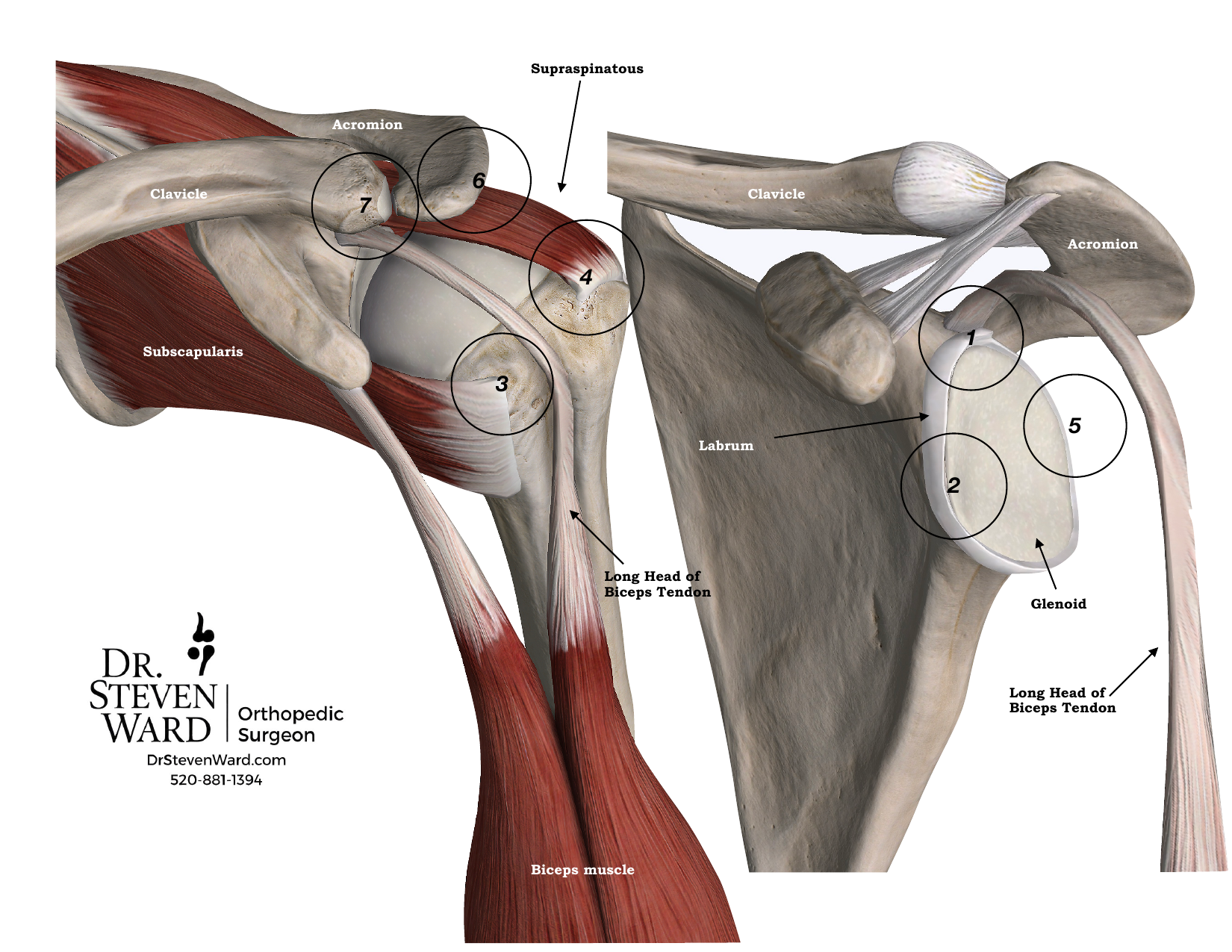
The shoulder is a ball-and-socket joint. The proximal humerus is the ball at the top of the arm bone. Just below the ball sit two bony knobs — the greater and lesser tuberosities — where the rotator cuff tendons attach. Those attachments are why tuberosity position matters for strength and raising the arm.
Surgeons often describe these breaks using a simple “parts” idea (the Neer concept, in plain language):
- 1-part — cracked but still lined up well
- 2-part — one main piece has moved (often the surgical neck or a tuberosity)
- 3- and 4-part — several pieces have separated, often including both tuberosities and the head
How many pieces have moved, how far, and whether the head itself is cracked help decide between sling care, fixing the bone, or replacing the joint with a reverse shoulder.
How we diagnose it
Diagnosis starts with how the injury happened and a careful exam of motion, strength, skin, and nerve and blood-flow status. Imaging confirms the pattern and guides treatment.
Exam
We check swelling, bruising, tenderness, and whether you can start the arm moving. We also check sensation and circulation. Soft-tissue swelling can make early strength testing uncomfortable; imaging fills in what the exam cannot show yet.
X-ray
Standard shoulder X-rays are the first and most important test. They show where the break is, how far pieces have shifted, and whether the joint is still lined up.
CT when needed
A CT scan adds 3-D detail for complex patterns, head-split fractures, or surgical planning. MRI is less often needed in the acute fracture setting unless soft-tissue questions remain after X-ray and CT.
Treatment options
Three common paths: non-operative care, open reduction and internal fixation (ORIF), and reverse total shoulder with DePuy INHANCE. Which one fits depends on displacement, bone quality, tuberosity reliability, cuff status, and your overall health — not a single birthday cutoff.
1. Non-operative treatment
Typical when: the fracture is minimally displaced or stable; many 1- and 2-part patterns that stay acceptably aligned; lower-demand or medically frail patients when surgery risk outweighs expected benefit.
Usually includes: early sling or immobilization for comfort, then progressive physical therapy to restore motion and strength as healing allows.
Some displaced fractures in older adults are still managed without surgery when alignment and function goals allow. That choice is made together after looking at the X-rays and your medical picture — not by age alone.
- Avoids anesthesia and implant-related risks
- May leave some deformity or stiffness compared with a perfectly restored anatomy
- Works best when pieces are close enough and early guided motion is realistic
2. ORIF (plate and screws)
Typical when: displaced fractures that can be stably reconstructed — often younger or higher-demand patients, or older patients with reconstructible bone quality; a displaced greater tuberosity (historically often discussed around more than about 5–10 mm of shift) that can affect cuff function; surgical-neck patterns with meaningful shaft–head displacement when fixation can restore anatomy and allow earlier motion.
Hardware: a locking plate and screws along the outer upper arm bone (proximal humerus). Brand choice is not the focus of this page; the goal is stable reconstruction of your own bone.
Caveats: osteoporotic bone, complex 3- or 4-part patterns, and poor tuberosity bone raise the risk of fixation failure, avascular necrosis (loss of blood supply to the head), and reoperation. In those settings, reverse may be the more predictable option.
- Keeps your own ball and socket when reconstruction is reliable
- Aims for anatomic alignment and early protected motion
- Success depends on bone quality and tuberosity healing
Patient-education diagrams: see OrthoInfo — Shoulder Trauma rather than hotlinked stock photos.
3. Reverse total shoulder (DePuy INHANCE)
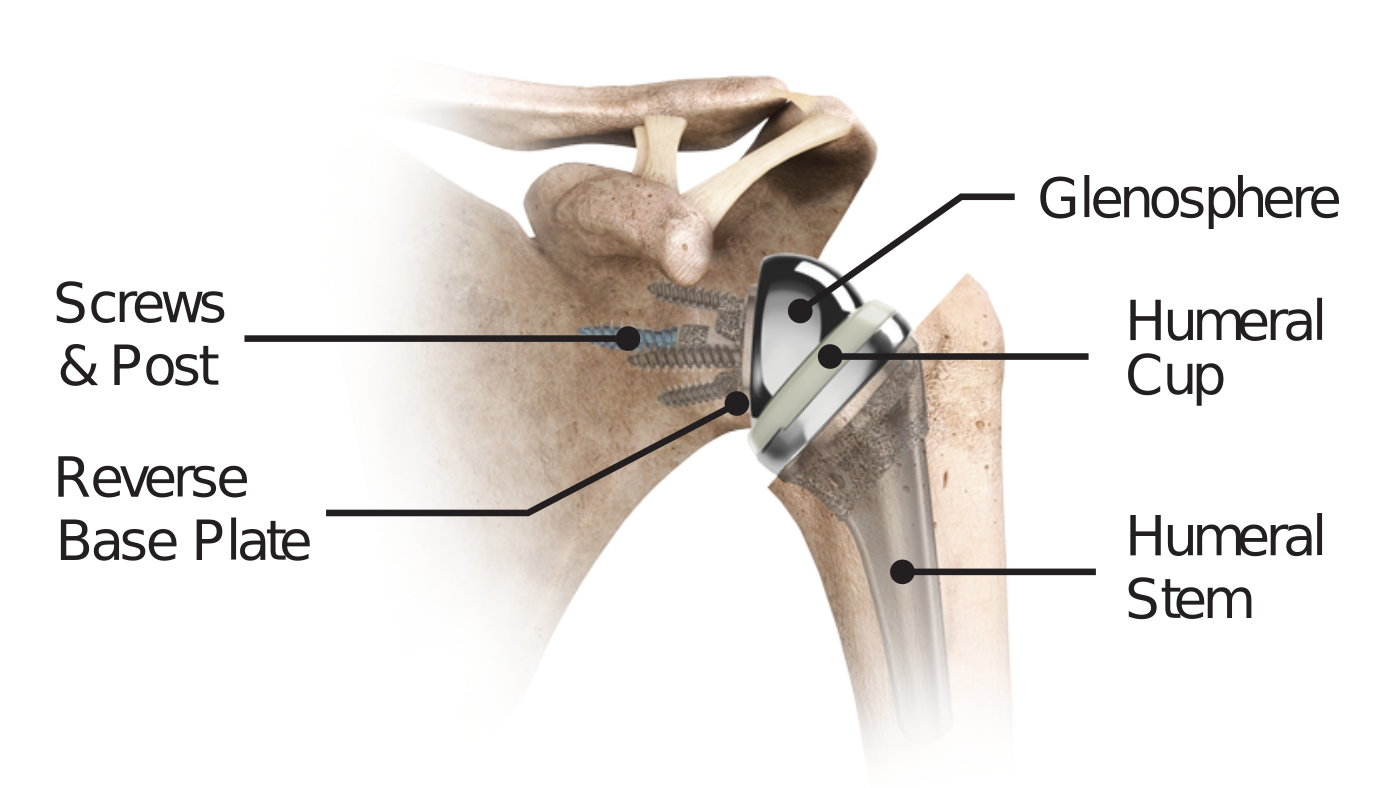
Typical when: complex 3- or 4-part fractures in older patients; an unreconstructible head or head-split; unreliable tuberosity healing or cuff deficiency; situations where stable ORIF for early motion is not achievable.
Why reverse: the large deltoid muscle powers elevation. Function depends less on perfect tuberosity and cuff healing than older hemiarthroplasty approaches. For fracture arthroplasty today, reverse is increasingly preferred when replacement is the right answer.
Hemiarthroplasty (replacing only the ball) was used historically for unreconstructible fractures. It is less common now when reverse is appropriate, because outcomes after hemiarthroplasty were more dependent on tuberosity healing.
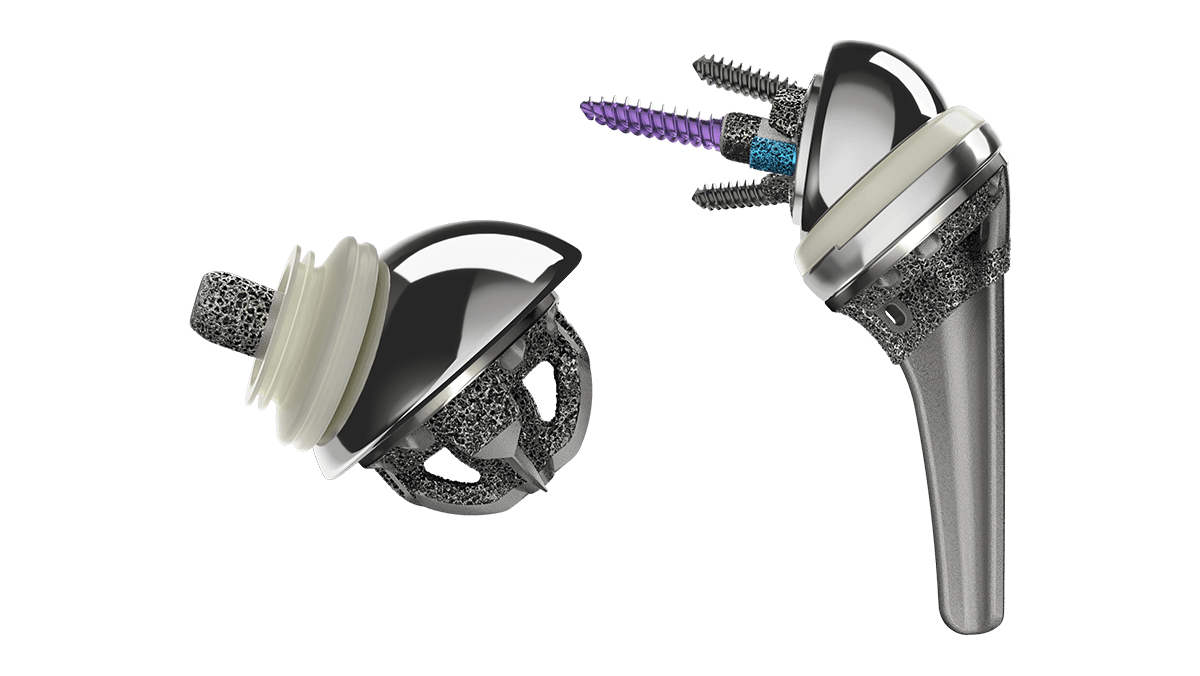
Dr. Ward uses the DePuy INHANCE reverse system for these cases. See also total shoulder replacement.
Comparing the options
No single path is “best” for every fracture. Dr. Ward individualizes based on the X-rays, bone quality, your health, and what you need the arm to do.
Non-operative
Who it’s for: stable or acceptably aligned breaks; many 1- and 2-part patterns; patients for whom surgery risk is high relative to expected gain.
Recovery flavor: sling early, then progressive PT. Improvement often continues over months.
Tradeoffs: avoids surgery, but may leave deformity, loss of motion, or weakness compared with a reconstructed anatomy.
ORIF
Who it’s for: displaced but reconstructible fractures, especially when bone quality and tuberosities support stable fixation and early motion.
Recovery flavor: protect the repair early, then guided PT. Timelines vary with the construct and healing.
Tradeoffs: preserves the native joint when it works; in osteoporotic 3- and 4-part patterns, fixation failure and reoperation risk rise — reverse may then be preferred.
Reverse INHANCE
Who it’s for: complex fractures in older patients, head-split / unreconstructible head, unreliable tuberosities or cuff deficiency.
Recovery flavor: sling protection early, then PT focused on deltoid-powered elevation; months to gain strength and confidence.
Tradeoffs: more predictable elevation when tuberosity healing is uncertain; it is still major surgery with implant-specific risks, so the choice is shared and individualized.
There is no automatic age cutoff. Literature and patient-education sources emphasize matching treatment to fracture pattern, bone quality, and goals. We review those factors with you in clinic.
What surgery is like
ORIF
Through an incision over the front or side of the shoulder, the pieces are lined up and held with a locking plate and screws. The goal is a stable reconstruction so protected motion can begin as healing allows. Hospital stay is often short; some patients go home the same day or after an overnight observation, depending on health and support at home.
You will have activity limits while the bone and soft tissues heal. Physical therapy is an important part of regaining motion.
Reverse (DePuy INHANCE)
The incision is typically deltopectoral — from just below the collarbone onto the upper shoulder. Damaged bone is removed and the reverse components are placed so the deltoid can power elevation. Tuberosities are repaired to the implant when possible to help rotation.
Most elective reverse replacements for arthritis are outpatient or short-stay; fracture cases are planned around your medical needs. A nerve block is often discussed for early pain control. Details of day-of care are similar to our total shoulder pathway.
Scheduling
You can schedule surgery in clinic with Dr. Ward, or call the office after your visit. Leave a message if needed. Preoperative instructions are reviewed before the day of surgery so you know what to bring, what to stop, and when to arrive. Fracture timing is coordinated with your medical readiness — we balance early care with safety.
Dr. Ward or a physician assistant will see you before surgery to answer remaining questions. Write them down and bring them to that visit. Clinic phones: La Cholla 520-881-1394; Oro Valley 520-901-6380.
What to expect
These are typical ranges, not guarantees. Your plan is tailored to the treatment chosen and how you heal.
Before
We review imaging, medical clearance when needed, pain control, and a physical therapy plan. If surgery is scheduled, you receive day-of instructions in clinic. Do not eat after midnight the night before surgery unless you are told otherwise.
Day of
Bring comfortable clothes, ID, insurance card, and a ride home. Dr. Ward and anesthesia meet you in pre-op. A nerve block is often discussed for shoulder cases. Length of stay depends on the procedure and your medical needs. He calls the person you designate when surgery is finished.
Recovery
Expect a sling for a period of weeks early on (often several weeks when you are up and moving — your exact instructions depend on ORIF versus reverse). Physical therapy usually starts within the first weeks. Comfort and motion often improve over the first few months; strength and confidence commonly continue to build for several months after that. Return to heavier work or sport is individualized.
Common questions
Straight answers to what patients ask most. If something still does not make sense, call the office or come in.
Does every proximal humerus fracture need surgery?
No. Many minimally displaced or stable fractures heal with a sling and progressive physical therapy. Surgery is considered when pieces are displaced in a way that threatens function, when reconstruction or reverse replacement offers a clearer path, or when non-operative care is unlikely to meet your goals.
How do you decide between ORIF and reverse?
We look at fracture pattern (including 3- and 4-part and head-split injuries), bone quality, whether the tuberosities can heal reliably, rotator cuff status, your health, and activity demands. Reconstructible bone in a patient who needs anatomic restoration often points toward ORIF. Complex osteoporotic patterns with unreliable tuberosities more often point toward reverse with DePuy INHANCE.
Why reverse instead of hemiarthroplasty?
Hemiarthroplasty replaces only the ball and historically depended heavily on tuberosity healing for a good result. Reverse uses the deltoid to power elevation and is less dependent on perfect cuff and tuberosity healing. When fracture arthroplasty is appropriate, reverse is increasingly preferred for that reason.
What implant does Dr. Ward use for reverse fracture cases?
DePuy INHANCE reverse. It is the same modern reverse platform discussed on our total shoulder replacement page — not an older Delta XTEND construct.
How long will I be in a sling?
Often several weeks while you are up and moving, with details that differ for non-operative care, ORIF, and reverse. Exact instructions are written for you after treatment is chosen. Stopping the sling too early can put a repair or reconstruction at risk; keeping it too long can worsen stiffness — we balance both.
When does physical therapy start?
Timing depends on the treatment. Non-operative care usually progresses from early comfort immobilization to guided motion. After surgery, PT often begins within the first weeks under protocol limits. See our physical therapy locations.
Will my shoulder be “normal” again?
Many people regain comfortable daily use. Some stiffness, weakness, or shape difference can remain, especially after complex fractures. Reverse aims for reliable elevation for daily activities rather than a perfect copy of the uninjured side. We set expectations honestly at the start.
Who will I see in clinic?
Dr. Steven Ward, with physician assistants Olivia Sobojinski, PA, and Gabby Ventura, PA. Call La Cholla at 520-881-1394 or Oro Valley at 520-901-6380.
Related resources
Total shoulder replacement Rotator cuff repair Physical therapy locations OrthoInfo: Shoulder trauma OrthoInfo: Reverse shoulderSchedule a visit
Call 520-881-1394 (La Cholla) or 520-901-6380 (Oro Valley) and we will find a time that works.
Call 520-881-13941521 E. Tangerine Rd, Suite 337
Oro Valley, AZ 85755 · (520) 901-6380
6130 N. La Cholla Blvd, Suite 135A
Tucson, AZ 85741 · (520) 881-1394